What Is Love? (Baby Don’t Hurt Me, Anymore)

The final message in our “Make Your Mark” series came from 1 Corinthians 13- also known as “The Love Chapter.” It is one of the most beautiful pieces of scripture (or any writing for that matter). 1 Corinthians 13 has found acceptance outside the church and finds its way into weddings, wall hangings, and all sorts of other places.

Couples will have the scripture read in weddings, and while it does talk about love, the chapter is not about marriage. In fact, Paul writes the chapter to explain what Christian love looks like to the churches at Corinth who are struggling to live in Christian love with one another and the community around them. They are clueless when it comes to love.

For the purposes of this post- love is an action and a commitment to put the other in front of ourselves. It is a lifestyle where model our lives after Christ who said, “Greater love has no one than this- to lay down one’s life for one’s friend (John 15:13).” If we are to make a mark as Christians and as a church- then our lives should be characterized by love; a sacrificial love that puts the other ahead of ourselves because God’s heart and love is turned towards the other (this includes us!!).

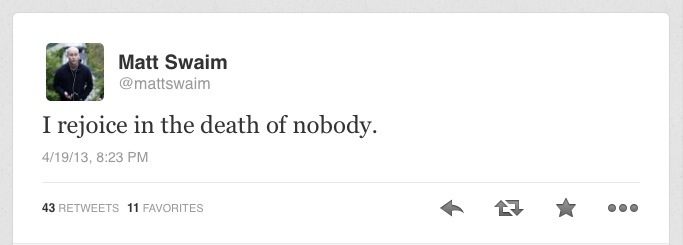
One of the most challenging parts of this message and preparation was the events that transpired in Boston, MA this week. As I sat, with many across our community and world, stunned about the bombing and the manhunt to catch the accused perpetrators, it became interesting to see some of the social media feeds and our attitudes towards our “enemies.” One of my college friends (@mattswaim) posted a tweet while the manhunt for the second suspect was nearing an end that captured what I was feeling- and praying others felt as well.

20130422-173438.jpg

While I had emotions and wanting to see some sort of justice carried out, I also wrestle with trying live out the example of Christian love that is contained in the scriptures. Jesus said in the Sermon on the Mount in Matthew 5:43-44, “You have heard that it was said, “Love your neighbor and hate your enemy. But I tell you, love your enemies and pray for those who persecute you, that you may be children of your Father in heaven.”

This is a hard text to live into during an emotional week like the past one has been. It is a hard text when we have people who come against us at work, in our churches (yes, even there), or in our families. But the highest living that we can aspire to is to love as Jesus loved. To not just love our friends- but to be active in loving our enemies by extending them grace, mercy, prayers, and our words and actions that point them to the love that we’ve received through Jesus.

As we are midway through a new week, the encouragement is to love- to love our neighbors, our brothers and sisters, our co-workers, our waitresses and servers, our bus drivers, professors- and yes, even our enemies. In a world filled with violence and hate- living in and living out the divine love of God is the best weapon we have been given to repel the darkness of evil and sin.

Posted in Uncategorized | Tagged , , , , , | Leave a comment

Promises in Times of Tragedy

Image

In the wake of the yesterday’s Boston Marathon Bombing, December’s Newtown, CT shooting and tragedies that have filled the news everywhere, I wanted to list a few brief promises or encouragements from Scripture. The bottom line is that tragedies will happen- and they will happen to us, whether on a large public scale or the tragedies that occur in our personal lives that very few people ever see. The question becomes how we respond to tragedies- or how our faith prepares us to walk through these times of trials.

  1. God is with us: In Isaiah 7:14, a passage that the NT views as a prophecy of the Messiah, we are told, “Therefore the LORD himself will give you a sign; The virgin will conceive and give birth to a son, and will cal him Immanuel.” Immanuel means, “God with us.” We can be encouraged that God is with us regardless of what we’re walking through.
  2. God Never Leaves Us: Deuteronomy 31:6 says, “Be strong and courageous. Do not be afraid or terrified because of them, for the LORD your God goes with you; he will never leave you nor forsake you.” In the midst of trials, tragedies, and difficulties we have a promise from Scripture that God does not leave or forsake us. It may sometimes feel that way, but we must have faith that God is there-even at our lowest points. This is reason for courage!
  3. God Leads Us Through Death Valley: In the 23rd Psalm, the Psalmist writes, “Even though I walk through the darkest valley (Valley of Death in KJV), I will fear no evil, for you are with me; your rod and your staff, they comfort me.” Again, we have a promise that God is with us, protecting us- and leading us through the most difficult of times. The Psalm doesn’t say that God will lead us around, over, or under- but right through whatever trial or tragedy that we are facing.
  4. God Weeps With Those Who Weep: One of the most powerful story in the New Testament is the story when Lazarus dies in John 11. Jesus was called to come to Lazarus’ aid, but didn’t immediately go. Lazarus dies and his sisters, Mary and Martha, are not very happy about it. When Jesus arrives and encounters Lazarus’ sisters, he is moved to tears. John 11:35 says that “Jesus wept.” This is important because Jesus is divine, Jesus is God. God weeps over the death of a friend. I have to believe that because of God’s goodness and love, that God weeps with those who weep. When we are broken; when we weep- we have a God who weeps with us. God is not unmoved- but moved by love and compassion. (By the way, Jesus also wept over Jerusalem before his death! Luke 19:41)
  5. Jesus Understands: The author of the book of Hebrews writes in 4:15, “For we do not have a high priest who is unable to empathize with our weaknesses, but we have one who has been tempted in every way, just as we are–yet he did not sin.” Jesus has been tempted and hurt in every way. He was tempted by Satan, he was mocked by the religious leaders, people tried to arrest and kill him, he was betrayed, abandoned, beat, and killed. Jesus, God-in-Flesh, went through all that and can identify and empathize with what we are experiencing. This means that we are not alone in the midst of trials and tragedies, even when it feels like it. Because Jesus can empathize, we can approach God’s throne of grace with confidence in order to find mercy and grace in times of need.

There are more promises and passages in the Bible that speak to our lives when we experience tragedy- but these promises are foundational to the life of a Christian as we deal with what is going on in our world. As Christians, we must develop a world-view that has faith that God is with us, for us, and not against. While this world-view will not necessarily lessen the blow of tragedy, it will help us frame what happen in a perspective that allows us to come to God, cry on God’s shoulder, and approach God’s throne to receive mercy and grace.

There is one final promise that I feel must be mentioned. It’s found throughout the Bible, most notably in the account of the resurrection and in Revelation 21. It’s the over-arching story of the Bible through all 66 books. That God is redeeming and making all things new.It’s the promise that evil and death are defeated, sin is defeated; brokenness is healed; captives are set free; there will be no more tears; no more pain; no more suffering; no more death- because God is making all things new through Jesus. When that day comes that God dwells with his people, creation will be redeemed and restored by the love that compelled Jesus to the Cross. That is something we can put our faith in!

Posted in Bible, Faith, In The News, Uncategorized | Tagged , , , , , | Leave a comment

Four Things I Wish I Knew Before Becoming a Parent

I’ve been going through some old tweets and instagram photos- and a common hashtag I use is #fatherhood and #parenthood. With two children- it’s a way of life. Parenthood has changed our life forever and I think there is no higher ministry than to my family and children. In light of this, there are a few things I wish I knew before becoming a parent.

1. Kids Change Everything: Ok, I’ve heard this from everyone when we told our family and friends we were expecting our first child, Abigail. And we knew that it would. I just don’t think I realized how much it would change our lives.

Andrea and I were married for eight years before Abbie came along. We went to bed when we wanted to and got up when we wanted to. When Abbie was born, it was a race to get to bed and go to sleep when she went to sleep because we knew she’d wake up. Before Abbie, when we wanted to go to the beach we would roll out of bed, put on our swim suits, grab a book and be on the beach in 20 minutes. Now, going to the beach requires filling up the back of our vehicle with blankets, towels, toys, umbrellas, more toys, food, drinks, more toys, clothes- and the list goes on. (Our first time taking Abbie to the beach, we forgot sunblock and had to overpay for something on the boardwalk!)

2. You’re gonna talk about poop a lot. No seriously, if you’re not yet a parent you have no idea what you’re getting yourself into. When a baby cannot talk, one of the best ways to know the child is healthy is the baby’s stool. Because of this, poop becomes an acceptable conversation topic at the dinner table, with other parents, and just about any time you can imagine. Never did I imagine the quantity of conversations that I would have around this subject. Just giving you fair warning.

3. You Long For Silence: Andrea and I like music a lot. Before kids we would listen to music all the time, have engaging conversations about life, dreams, and ministry. Now, between listening to “Old MacDonald Had a Farm” for the millionth time, hearing the kids scream, and answering Chloe’s questions that she’ll keep asking until we acknowledge her- there are times when all we want or need is some silence.

That’s probably a healthy thing. Not there there is anything wrong with our kids talk or questions (I love their questions), but there are times when I need to decompress and process what is going on in the day-to-day and process where we are as a family. Before kids, these periods of silence where easy to find and create- but now they are worth a fortune and are like finding the Leprechaun’s pot of gold!

4. Your Heart Grows Even Larger: I never knew how much I would love our first daughter, Abbie, until she was born. She was simply amazing. Holding her and seeing her grow and develop was a real blessing. It was three years with Abbie before Chloe arrived. I have to admit that I was a little nervous about a second child. How could I “share” my love with another daughter. Again, the wisdom from those who have been there before said that you don’t share love- but your heart has a greater capacity to love. Guess what? They were right.

When Chloe arrived, I didn’t have to take any love away from Abbie- but there was the ability to love each one of them fully. While the Grinch’s heart grew three sizes bigger on Christmas morning, I feel like my heart grew even larger than that with two kids. Our capacity to love for children is a blessing.

And here’s another one for good measure…

5. Parenting Teaches You So Much About God: Through much of the Bible, there is language of God as a Father/parent. Being a father for nearly six years, there is much to learn from parenting about God (and more than this post can contain.) I want to give my children every blessing and opportunity possible. I am fallen and sinful- yet this is my desire. How much more is God’s desire to love us, bless us, and protect us? There are so many ways this could be discussed, and we need to consider how parenting can teach us about God.

What did you wish you knew before you had kids? How has being a parent taught you about God?

Posted in Family, Uncategorized | 4 Comments

Make Your Mark: Body Be

Yesterday was week number two in our series called, Make Your Mark. Last week, we looked at how each Christian is gifted by the Holy Spirit to take part in God’s work here on earth. Basically, if God calls us- God will equip us.

This week, we looked at the second half of 1 Corinthians 12 and Paul’s image or metaphor of the church as a body- specifically the body of Christ. Each believer has a role (or gift) to use in the body of Christ. For the Body to function properly- everyone must use their gifts. Throughout the chapter, Paul highlights unity within diversity (12:4, 5,6, 11, 12, 13, 20, 25-26). As the physical manifestation of the body of Christ in the world, the Church is to find unity amongst it’s many members, gifts, experiences, and dreams.

Of course, unity is quite the challenge. How does a church, made up of many individuals find unity- where does it find unity.

Jesus is the obvious answer. We call ourselves Christians because of our faith in Jesus and our desire to daily surrender our lives and live as a disciple. Without Jesus’ incarnation, life, death, and resurrection- there is no Church, no body. Our unity is found in Jesus- and the mission that Jesus calls us to take part in as Christians.

Fellow UMC Pastor and Blogger Matt Lipan wrote a post last week about vision and mission (read it here). In the post, he gives what I thought was a helpful image. In our organizations and churches, we can get lost in the sea of vision, mission, values, purpose, etc. What is needed in the turbulent is an anchor point to provide stability. He suggest, and I agree, that the anchor point is mission.

The Church is often described as the hands and feet of Jesus. If that is true, our unity as the body is found in our common salvation and experiences of God’s grace- and the mission that God has called us to. This mission is too Love God and love others (Mark 12:29-31) and to make disciples (Matt 28.19-20). There are many things in the Church that we can discuss and debate, but our anchor is Jesus and the mission to love others and to make disciples of all nations. This is where we find our stability.

Where does your church or ministry find it’s anchor? How do you keep the mission of the Church the main thing? Are there other anchors that you’d suggest?

I couldn’t help but think of a classic ’90’s song while studying this passage last week: Johnny Q. Public’s, “Body Be.”

Posted in Uncategorized | Leave a comment

Make a Mark: You’re Gifted

This past Sunday, we began a brief sermon series called “Make Your Mark.” The purpose of the series is to encourage those attending Hope Church to understand and take hold of the ministry opportunities that God gives us- and the gifts to achieve those opportunities. Our focus for the series is 1 Corinthians 12-13.

1 Corinthians 12:1-11

This is a main text of Paul about Spiritual Gifts. It was interesting as I received some feedback after church that not many of our folks have heard much about spiritual gifts. This will likely be a place to return to focus on again later.

To me, as I read and preached, the main essence of the passage is found in 1 Corinthians 12:7: “Now to each one the manifestation of the Spirit is given for the common good.” God gives spiritual gifts to each believer which is to be used for the common good. Gifts are not meant to build up ourselves but are to point others to Christ.

We went into a brief description of the gifts listed in 1 Corinthians 12 and elsewhere knowing that they would need some definition. While we spoke of the spiritual gifts listed, I said that any gift, talent, ability, or endowment- whether cultivated through practice or divinely given- can be a spiritual gift when used to glorify God and participate in God’s kingdom work. But here are the main points of the message

1. You are gifted to make a mark: vs. 11 “All these are the work of one and the same Spirit, and he distributes them to each one just as he determines.” Gifts are distributed to each believer as God determines. The challenge for each of us is to discern, with the help of mentors, pastors, friends, and assessment tools, what our spiritual gifts might be.

2. Gifted to Get Involved. Romans 12:1-8 speaks to this. In vs. 1-3, Paul talks about spiritual transformation that takes place when we surrender our lives to God as a living sacrifice. Verses 4-8 speak to putting our gifts into action. After spiritual transformation by God, the task of a believer is to use their gifts- to put them into practice- to get involved in ministry that makes disciples and takes part in the kingdom.

My dad has an awesome garage. In his garage is just about every tool imaginable. There are tools to fix cars, tractors, work on the house, cut trees and so on. I knew growing up that if I needed a tool for a job- that I could go to the garage and find the right tool for the job. Likewise, when God gives us a mission/purpose/ministry to fulfill, God will equip us with the tools and gifts to do what God has called us to do.

What are your spiritual gifts? Did you hear much about gifts in the church? What is the best gifts assessment tool that you’ve used?

Posted in Uncategorized | Tagged , , | Leave a comment

Ruth 1: Leaving the Old Life Behind

I’m posting summaries on our Ruth sermon series throughout Lent. Part 1 can be found here. You can listen to the audio of the sermons (when our recorder works) here.

In part one of Ruth, we saw how Ruth’s mother-in-law was filled with bitterness about the experiences that she had in life. She endured a famine, a move to a foreign country, the loss of a husband, and the loss of both of her sons. When she arrived back in Bethlehem to resume life there- she said that she was returning bitter and empty-handed (even though Ruth was with her)

Ruth is a secondary character in the first chapter- but a powerful one. If Naomi is a picture of bitterness in the face of trials, Ruth shows us the opposite. She has lost her husband, has no kids (no male heirs), no property, and no prospects of another husband related to her deceased one.

Her mother-in-law, Naomi, tries to persuade Ruth (and Orpah) to return to their families to restart their lives there. Orpah returns while Ruth stays- saying:

“Don’t urge me to leave you or to turn back from you. Where you go I will go, and where you stay I will stay. Your people will be my people and your God my God. Where you die I will die, and there I will be buried. May the Lord deal with me, be it ever so severely, if even death separates you and me.” When Naomi realized that Ruth was determined to go with her, she stopped urging her. (Ruth 1:16-18, NIV)

Ruth tethers herself to her mother-in-law, making an oath to care for her through death. This statement is powerful because to do this- it means leaving behind her old life. She will leave behind her parents, any siblings, her friends, her customs, her religion to begin a new life with Naomi. And where Naomi needs to leave some things behind (bitterness)- Ruth is choosing to leave behind the old life for the new.

Ruth is a powerful illustration of our life with Jesus. The call to discipleship- to be a follower of Christ- is the call to leave behind the old life and follower wherever Jesus leads us. Paul writes:

“Therefore, if anyone is in Christ, the new creation has come:The old has gone, the new is here!” (2 Corinthians 5:17, NIV)

In Christ we can experience a new life; we experience a transformation where the old life is gone. Where we are dead to sin but alive in Christ.

Are there things that we need to leave behind? Are we still holding on to part of the old life? Have we experienced transformation through the grace available in Jesus Christ?

Posted in Bible, Hope Church, Sermons, Uncategorized | Tagged , , | Leave a comment

Ruth 1: Letting Go

hands.letting.go_1

Hope Church- where I pastor- is studying the Book of Ruth during the season of Lent. I love Ruth because it is short (4 chapters), yet in it we see many modern issues that allow the Holy Spirit to speak to us in powerful ways. You can listen to the sermon from week 1 here. (Unfortunately, there were technical issues that prevented week 2 from being recorded.)

The back story of the book of Ruth is a famine. It threatens Elimelech and Naomi’s livelihood to the point that they uproot and move from Bethlehem for the foreign nation of Moab. Once there- Elimelech dies, his two sons marry Moabite women; ten years later, both sons are dead- leaving Naomi with two foreign daughter-in-laws in a time when they needed a husband to offer protection and provisions.

Naomi decides to go back to Bethlehem (where the Lord has again brought food), where she has extended family and hope. She urges both Orpah and Ruth to go back home to Moab to re-start their lives there. Orpah decides to go back. Ruth stays.

When Naomi and Ruth come to Bethlehem- Naomi describes herself as bitter. She has experienced famine, the loss of a husband and two sons. She tells her family, friends, and community that she has come back home empty handed (never mind that Ruth is there) and that it is the Lords doing that she is empty.

What do we do with tragedy? With Trials?

What do we do with death? Unemployment? Getting behind in our rent/mortgage?

In Naomi, we see someone who is wrestling with bitterness. She has lost her husband, two sons, and now is starting over in life.  She will have to let go of bitterness in order to take hold of the life God has for her.

How often do we face trials and tragedy that leave us filled with bitterness or anger? How many grudges are we holding onto? Are we struggling with unforgiveness? Are the things we are holding on to keeping us from experiencing the life God has for us?

My prayer for the people of Hope Church- and for you reading this- is that regardless of what life has brought us, that we would let go of anger and bitterness; leave those things behind and walk with God in the life God desire to give us.

Posted in Bible, Hope Church, Uncategorized | Tagged , , , | Leave a comment

Beyond The Retweet

Image

Today, you may have notice that Twitter and Facebook were a little quieter than usual. Part of the reason was a “social media blackout” to create awareness for human trafficking and slavery that exist in the world today. @enditmovement is the official twitter handle of the day- which received a big boost from the Passion Conference earlier this year. Most estimates I’ve read have around 27 million people are trafficked or in slavery—and this kind of oppression is worse today than at the height of legal slavery.

I am opposed to human trafficking and slave trade at all levels. It’s abhorrent that this continues to exist in our world. Scriptures are clear in Genesis that every human being is created in the image of God- and has divine worth. How can we “buy/sell/trade” another human made in the image of our Creator?

I do, however, question social media activism and wonder if it is sometimes a shortcut to really getting involved. It’s easier to click “like” on a Facebook page or RT something on Twitter to raise awareness- it’s another thing to actually send funds or give of your time and talent to get along. What would happen if everyone who went silent today (or took part in other campaigns) wrote their government representatives; or financially supported a church or non-profit working in this area; or used their talents to join a non-profit working to end slavery?

Perhaps, for some, it is the start of a process. By “liking” or supporting a cause on Facebook or Twitter- it does put it into a frame of thinking about the topic. We have awareness; a seed has been planted. Some of those seeds, when fed a healthy dose of passion creates opportunities for you and I to get involved.

I applaud the efforts of @enditmovement and those who went silent today. We, especially those of us who call ourselves “Followers of Jesus Christ,” should be in it to end it. I encourage each of us to prayerfully consider how God is calling us to go beyond “liking” or “retweeting” a campaign to using our God-given gifts in talents to, “preach good news to the poor, proclaim freedom to the captives, recovery of sight for the blind, to release the oppressed and to proclaim the year of the Lord’s favor.”

Were you “in it to end it” today? How has social media given you a platform to raise awareness? How are you being led to go beyond “likes” and “retweets” to getting more fully involved?

Posted in Uncategorized | Tagged , , , | 3 Comments

An Introduction to Fasting During Lent for Non-Liturgical People

fasting

For the past two and a half years, I have been pastoring Hope United Methodist Church, a growing church that has a history of less than 10 years. There is a mixture of worship experiences within the church. Some come from a liturgical background while others come from little or no church background. Hope is a come-as-you-are, let’s study the Bible and get our hands dirty being the church kind of church (at least I pray we are). While we have band-led worship, don’t wear robes, or have an acolyte- the seasons of the Christian worship calendar are important to me as I plan worship.

Lent, perhaps, is my favorite. Here is why.

Lent is 40 days (not counting Sundays), beginning on Ash Wednesday (Feb. 13 this year) and ending on Easter Eve, where we experience a different rhythm to our spiritual lives. It is a season of introspection, self-reflection, and seeking to identify with the suffering of Jesus. This is preparation for our Easter celebration that Jesus is not dead- that he has risen. Therefore we have hope that our sin, pain, and brokenness will one day be healed and we will rise with Christ.

But that’s Easters…

In Lent, we practice spiritual disciplines that helps us become more aware of the Holy Spirit in our lives, more aware or our need for grace, more aware of the costly gift that Jesus provided for us on the Cross at Calvary.

One of those disciplines is fasting.  Fasting is abstaining from food (or something else) for a set amount of time for the purpose of prayer, confession, and penance. It is important to remember that fasting should be coupled with prayer and/or the study of Scripture (or another discipline)- if not, fasting becomes dieting!

It’s pretty common for people to give something up for Lent. Some of my favorites that I’ve heard over the years are skydiving, bull riding, and my friend who gave up giving anything up for Lent. Fasting is supposed to help us to identify with the suffering the Jesus endured, then the activity, item, or habit that we abstain from should cause us a little discomfort. Each time we feel the discomfort (hunger pains, the temptation to get on Facebook, headaches from a lack of caffeine), we are reminded to pray- giving thanks to God for Jesus and the suffering He endured on our behalf and to ask God to refine our lives to be more like Jesus.

We also recognize that every Sunday is Resurrection Sunday and that we don’t fast on Sunday because we celebrate the resurrection. Again, this doesn’t make Sunday a “cheat day” (for all you dieters out there), but we enjoy what we’ve refrained from to celebrate the resurrection of Jesus. And after all our fasting, Easter Sunday becomes the ultimate celebration as we recognize that Jesus is alive- and that we can find life in Him.

Are you fasting for Lent? What has been your fasting experiences? Anything that God revealed about yourself as you fast during Lent?

Posted in Hope Church, Uncategorized | Tagged , | Leave a comment

Confessing to Failure

Image

I failed a few weeks ago.

I failed to the point that I keep thinking of this incident and I’m ashamed about my response.

A few weeks ago after church, I was rushing around getting things cleaned up (we rent space, so we set up and tear down on a weekly basis) when I needed to take some things out to my car. That’s when I saw her. She was an African-American woman, who was well dressed and appeared to be coming from church. She walked with a cane. When I came near to hear on my descent down the outside stairs, she asked me if I had any money for the bus. I rarely carry actual, physical money with me anymore- and in general, I don’t hand money out to those who ask, preferring to help them with what they need (this is important as a downtown church). So I told the woman that I did not have the ability to help with bus money (which was true).

Here is my failure: I cared more about getting cleaned up that day than listening to the woman. I cared more about getting to my next “thing” than finding out what this woman really needed. It’s possible someone could have given her a ride- or helped with bus fare. I cared more about me than I cared about another.

There are two scriptures that come to mind:

Matthew 25:21-44: The parable of the Sheep and Goats. It’s a story of judgment on those who failed to care for the poor, the hungry, the naked, and the thirsty. This is certainly a goat moment for me.

Hebrews 13:2- “Don’t neglect to open up your homes to guest, because by doing this some have been hosts to angels without knowing it.” While I wasn’t asked to open up my home- I think basic hospitality is caring for those around us. What kind of blessings do we miss for rushing out of situations like this?

I’m praying for the ability to live in the moment; to live out my faith where I’m at rather than looking past to where I’m going.

Is there a time where you feel you missed on an opportunity to be the hands and feet of Jesus? What happened? Have you ever lived in the moment and “entertained angels” and been blessed?

Posted in Bible, Faith, Uncategorized | Tagged , | 3 Comments