Submitted

What does a life of submission look like for a believer? What does it look like to practice a lifestyle of submission. This is the question we sought to answer this past Sunday as we looked at Spiritual Habits (Disciplines) for Ordinary People.

As I spoke with people in the days leading up to Sunday, submission often brings up negative images or thoughts. There were more than a few references to the series, Fifty Shades of Gray, and it’s story of domination and submission. This series has been quite successful- which leads to some other questions- but this was a common view of submission.

As a church and as disciples of Jesus- we must practice the thoroughly Biblical idea of submission because submission was practiced by Jesus. Submission is essential and central to the life of the Disciple because Jesus submitted; Jesus, even though He is God- submitted to become human; Jesus submitted to a criminals death on the cross even though he was sinless. Why? Because Jesus’ love for you and for me led him to redeem us through his life, death and resurrection. (See Philippians 2:3-11). Out of our love for God, we are led to submit to those around us, raising them up and pointing them to the redemption that God offers through Jesus Christ.

So what does a life of Submission Look like?

  • We would invert the natural power structures that are present in our culture. The poor, the lame, the sick, the imprisoned, people with disabilities, and the elderly would no longer be the people we avoid- but they become part of our everyday lives. We submit our time and our energy to care for them, to befriend them, and to learn from them. We have much to learn from the poor and those in low position- and if we think that we cannot learn from them- then for us, submission will be a problem.
  • For those of us who are married or who will seek to be married one day- we would learn (or continue to learn) mutual submission. What makes a lasting marriage and relationship is not seeking to gain what we want- but submitting our desires, needs, and wants in order to fulfill our spouses needs and wants out of our love for them and our love for God.
  • As parents and as bosses (they are not that different!), it means rather than holding onto the authority that we have because of our position; rather than demanding that others serve us- a life of submission means that we serve those around us. The true Christian leader is a servant above everything else. Living a life of submission means that we exist to serve rather than be served.
  • For Children- submission means obeying our parents, knowing that it is the only commandment in the “Ten Commandments” that carries a promise- “Honor your father and mother, so that you may live long in the land of the LORD your God is giving you.”
  • For those of us seeking to live as disciples- the only response we can possibly have to God’s love is total submission- total surrener to God. All of who we are, what we own, what we do, how we live to God. Our lives are a gift from God. They are not our own. Awareness of God’s grace creates an opportunity to submit who were are, what we are and all that we might become to God.

Chris Heuertz, in his book Simple Spirituality, shares a story from South India about a boy who loved to play marbles. He would walk around hoping to find opponents to play against. He had one marble in particular, a special blue marble, that had won him many matches.

One day, while looking for an opponent he encountered a young girl who was eating a bag of chocolate candy. Though the boys love was marbles, he had a weakness for chocolate. He concocted a plan. “How about I give you all these marbles for those chocolates?” The girl replied, “Sounds good to me.”

The boy put his hand in his pocket, searching for the distinguishing features of his blue marble. Once he identified it with his finger tip, he carefully pushed it to the bottom of his pocket and pulled out all the other marbles.

As he handed the marbles to the girl in exchange for the chocolates, the boy thought his plan was a success and turned to walk away. As he began to eat the candy, he suddenly turned to the girl and asked, “Hey, did you give me all the chocolates?”

In our own spiritual lives, we live just as defiantly to God. We demand every blessing, every gift of the kingdom, everything that God has to offer. We want our prayers to be answered, to be close to Jesus, in short- we want it all. But we are unwilling to give up everything for it.

We may have our own “blue marble” in our lives this morning that we are unwilling to surrender or submit to the control of God. Like the child, we hold onto this “blue marble” while expecting to experience the fullness of God in our lives. But until we offer ourselves in total surrender, and become disciplined at submitting to the will of God- our participation in the life of God will be limited and incomplete.

How do you understand submission within the Christian life? What is your “blue marble?” What keeps you from surrendering your ‘blue marble’ for the life God desires your to have?


Posted in Bible, Sermons | Leave a comment

Living in the Moment (and other lessons from the Pirates)

Image

I am a Pittsburgh Pirates fan.

Let me be clear, I am not a recent bandwagon fan- but a fan from birth. A fan whose love for the Pirates came together around players like “skinny” Barry Bonds, Andy Van Slyke, Bobby Bonilla, Mike “Spanky” Lavalliere, Chico Lind, Sid Bream and many more. I was present during the 1997 “Freak Show” season when Francisco Cordova and Ricardo Rincon threw a combined no-hitter that was won on a Mike Smith 10th inning walk-off home run. And I have rooted for the Pirates for the last 21 years of losing seasons without a playoff appearance or win- until last night.

The Pirates 6-2 win over the Reds was everything I hoped it could be and more. Mostly- that we got past the “play-in, play-off” game to the “real playoffs” versus the Cardinals. Since the win last night, I have been savoring the sounds, the sights, and the memories (Like watching with my two daughters- of which one is developing into a Pirates fan!).

Here is the lesson of 21 years of losing for me. Be present in the moment because you don’t know what tomorrow will bring.

When Sid Bream scored ahead of Barry Bonds’ (candy-arm) throw in the 9th inning of Game 7 of the 1992 NLCS- sending the Pirates home and the Braves to the World Series, my thought was that it wouldn’t be long until the Pirates would be back. Five years later, the 1997 “Freak Show” team made a run at the playoffs and fell short. The 2000’s were abysmal (Thanks for nothing David Littlefield). And now, 21 years later, we finally have a winning season and a playoff victory.

21 years ago, I would have never thought it would have taken this long.

This is why I’m savoring the moment. Soaking in the memories. Because we really never know what tomorrow (or the next day might bring).

Jesus, in Matthew 6:34- “Do not worry about tomorrow, for tomorrow will worry about itself. each day has enough trouble of its own.”

How often do we get caught up thinking about tomorrow, or next week, or next month that we miss out or become unaware of what is happening now? It is easy getting our minds caught up in other things (Facebook, texting, etc.) that we are not truly present in the moment. But the moment is all we have. While there is nothing really wrong with hopes and dreams for the future, if we live with our head in the clouds about tomorrow we miss out on what God has for us today. This moment.

In the Lord’s Prayer in Matthew 5:11, Jesus says, “Give us today our daily bread.”

In other words- Jesus says not to worry about tomorrow’s bread. But give us today. Provide for us today. Sometimes, I am guilty of thinking about tomorrow to the point that I miss out today. And I have to much to be present for today; my faith, my wife, my two daughters.

As you read this- think about the Pirates, who went from one of the most successful teams in the early 1990’s to 21 years of losing. Be present in the day that God has given you. Savor the moments and the relationships. Live fully into the life that God has for you without worry about where God will lead you tomorrow.

And one more thing- Go Pirates!

Posted in In The News | Tagged , , , , , , | Leave a comment

The Simple Life

For the past few weeks at Hope Church, we’ve been talking about the need for Christians to develop spiritual habits in our lives in order to grow mature in our faith (read pt.1, pt. 2, pt. 3, and pt. 4). We have to “feed ourselves,” to use an image from the bible, and grow past an elementary understanding of our faith. These practices, habits, and disciplines put us in a place to allow God to transform us from the inside out. In a world where our lives are filled with clutter, noise pollution; the temptation to shase after money, possessions, security, status- we need a disciplines or a habit to combat the tendencies we have to accumulate and clutter our lives.

In a world of excess, we need to develop and practice the discipline of simplicity.

Simplicity, according to author Richard Foster, is “an inward reality that results in an outward lifestyle.” It is something that begins in our hearts and in our spirit and result in a lifestyle.

We can say that simplicity is centering our hearts on the things of God, who is our Divine Center (again an idea from Foster). When our hearts are centered on God- our lifestyle begins to reflect this inner reality. When we practice simplicity, possessions, status, security, or wealth are not are masters. God is our center. We no longer worry about tomorrow, or security, or about our appearance or our reputation before others because our desire is to simply center our lives upon God and God’s work through Jesus Christ.

So How Do We Cultivate the Habit of Simplicity?

There is a lot to be said for simplifying our lives. About a year ago I watched a story on the Today show about a guy doing the 100 item challenge. The challenge is to get rid of everything you own until you only own 100 things. 10 pair of socks? That’s 10 items. Two couches and a chair in your living room? That’s three items. Needless to say, most of us own 100 items without getting out of our bedroom. But simplicity is more than just getting rid of things or living sparsely.  For simplicity to be a spiritual habit or discipline- it has to connect us to the reality of God in our lives and in our world. Jesus tells us how to practice the discipline of simplicity in Matthew 6:33.

“But seek first his kingdom and his righteousness, and all these things will be given to you as well. Therefore do not worry about tomorrow, for tomorrow will worry about itself. Each day has enough trouble of its own.”

In chapter six, Jesus tells disciples not to run around chasing after money, wealth, or clothes. He even tells them not to worry about necessities. Their lives should come down to one thing. One thing that should be first. Jesus tells them to seek first God’s kingdom and God’s righteousness. This is the priority. Seek first the kingdom of God- and the rest of our lives will take care of themselves.

So what does it mean to seek the Kingdom of God? What is the kingdom of God?

From a theological side- the Kingdom of God is the reign of God here on earth. The Kingdom of God is most evident in the incarnation, life, teaching, example, death, and resurrection of Jesus and his ministry of healing, caring for the poor, justice, redemption, and salvation. The kingdom of God is about the Hope that will redeem creation through Jesus.

Now, we see evidence that this Kingdom is present- most fully in the life of Jesus. But we see much more evidence that God’s reign on earth is still coming. We see sin, brokenness, hurting people, war, natural disasters, broken relationships, child abuse, spousal abuse, and the list goes on and on. This is not God’s will, and the witness of the scriptures is that God is at work now redeeming and restoring people’s lives, relationships and even restoring creation.

Seeking the kingdom means that we’ve sought after God and have experienced salvation and redemption through the death and resurrection of Jesus. Seeking the kingdom means that we are new creations by the grace of God. Seeking the Kingdom means that each day we are seeking to live a more Christ-like life.

Because we are seeking a more Christ-like life—

  • When we serve the poor, we are seeking the kingdom
  • When we feed the hungry, the kingdom is present
  • When we provide sight for those who cannot see- the kingdom is here
  • When we forgive our neighbor, our spouse, our enemy- we are seeking the kingdom
  • When we seek to restore relationships- we are seeking the kingdom
  • When we seek peace- we are seeking the kingdom
  • When we share the Good News about Jesus Christ- we are seeking the kingdom

Simplicity, then, reorients our lives around our Divine Center- who is God- to the point where our possessions (or pursuit of things) does not keep us from experiencing the fullness of God in our life.

Simplicity is a habit of laying down our worries and concerns, laying down the things that keep you awake at night, at the feet of Jesus in order to focus on what is at the heart of God.

Simplicity is when the thing that we hold onto the tightest are not possessions or earthly treasures, but when we hold on tightest to Jesus.

Simplicity isn’t always about what we give up, but what we hold onto.

There is a story about John Wesley- the founder of the Methodist movement that goes like this.

One day, John Wesley went into town to purchase some pictures for his house. After hanging the images around his house, he heard a knock at the door. It was bitterly cold outside, and the wind was blowing. There stood a young woman and her obviously undernourished baby in arm, both poorly clothed. They were going from door-to-door begging for food and money to provide them with warming clothing.

Wesley put his hand in his pocket and pulled out what little change was left over from his day of shopping. He handed it over and sent the woman on her way. When he closed the door behind him and turned around, the pictures on his walls faced him as judges, the money he had spent on those very frames could have helped the young mother.

Upon seeing the frames, Wesley fell to his knees and made a pledge to God: he promised that if God would provide for his basic needs, then he would give everything beyond that to those in poverty. Wesley determined that to live a sufficiently austere lifestyle, he would need twenty-eight British pounds a year. During the next year, Wesley earned 30 pounds and gave 2 pounds to the poor. The second year he earned nearly 60 pounds, the third year almost 100. By the end of John Wesley’s life he was earning over fourteen hundred British pounds a year- living off of twenty-eight and giving the rest to help meet the needs of people who were poor. (I’m no Wesley Scholar, but read this story in Christoper Heuertz’s (@ChrisHeuertz) excellent book, Simple Spirituality)

Simplicity- seeking the kingdom- is not always about what we give- but about what we keep and how it can become a barrier from being Kingdom minded or a catalyst for being Kingdom minded.

Are there things in your life (Clutter, noise, addiction, etc.) that prevents you from practicing simplicity that is focused on the Kingdom of God? How do our possessions prevent (or assist?) you in identifying with the poor and the oppressed?

Posted in Bible, Sermons | Tagged , , , | Leave a comment

Why We Fast

The first time I remember fasting was as a teenager doing an event called the 30 Hour Famine- now this wasn’t “real” fasting as we’ll see, but it was my first experience and exposure to the concept. I remember going through the day without food and gathering after school for a lock-in. By the time we were done fasting 30 Hours later, I thought I could eat a horse- and evidently I tried as I felt as sick as could be after eating. Most of the time, when we hear of fasting in our culture, it comes from having to get lab work done or fasting before a medical procedure. But fasting is long held- and biblical discipline that ordinary people of thousands of years have practiced to encounter the presence of God.

Fasting is abstaining from food for spiritual purposes. Fasting is always centered upon God. In the Old Testament, people fasted out of obedience to God, as a sign of repentance, because they’ve experienced great sorrow, or they fast praying for God to intervene. Fasting is both a corporate and individual practice. Fasting is a private or inward practice where we abstain from food in order to center our lives on God and to express our repentance for our sins, to express our sorrow, and our hope that God would intervene in our lives.

I believe that fasting is a powerful discipline or habit to develop when it is accompanied by prayer and study and centered upon God because in this practice- we discover that it is not food, or technology, or ourselves that sustains us- but we are sustained by God. Fasting reveals that we cannot deal with the things that control us (sin, anger, lust, bitterness, hatred, etc.) on our own. We must cry out to God to intervene in our lives.

Why do we fast? It’s really the same answer as with why we study or pray: We fast seeking God to intervene in our lives and to change us from the inside out. We fast because we recognize our sin and our need for grace. We fast because we want to go to the places to encounter the divine presence of God and for God to transform us through God’s love. We fast because we have a longing for God and we know that when we encounter the presence, power, and love of God we will never be the same!

What do you think of when you hear about “fasting?” How might your spiritual life be different if you had a habit of fasting/prayer/study where you regularly encountered the presence of God?

Posted in Sermons | Tagged , , , , , | 1 Comment

How Do We Study?

Woman Studying

Yesterday, I posted on the Spiritual Habit/Discipline of Study- defining study as a specific act where we fix our eyes on an object (like Scripture) in order to be changed. When we study scripture our minds are conformed around the things of God.

So the question is- how do we study? How do we study the Scriptures? Richard Foster, in his book Celebration of Discipline suggest four steps of study.

  1. Repetition– we need to take time to read a passage over and over again. This allows it to get into our hearts and mind.
  2. Concentration– cannot study with the TV, radio, or iPad on around us. We should focus solely on what we are studying.
  3. Comprehension– focuses on understanding. Seeking a lightbulb moment where we begin understanding the text.
  4. Reflection– Foster says that reflection defines the significance of what we are studying. Foster again writes, “Reflection brings us to see things from God’s perspective. In reflection we come to understand not only our subject matter, but ourselves.

I have always encouraged people who are just beginning to read the Bible and just beginning to study to begin in a Gospel. Some say John, I like Mark- but the point is beginning somewhere. But like prayer- we have to make time and space to study.

I think it is important to have a notebook and pen when we study to write down questions, observations, and our lightbulb moments. They can also be written in the margins of our Bible.

As we reflect on the Scriptures- I try to ask five questions:

  1. What does this passage mean?
  2. What does this passage teach me about God?
  3. What does this passage teach me about Jesus?
  4. What does this passage teach me about myself?
  5. What is this passage calling me to do?

Having a notebook handy, you can write out those questions- and begin writing your responses as you read and study the Scriptures. When you become disciplined to have this divine appointment with God on a daily basis- you put yourself in a place to encounter God through the Scriptures and be transformed from that encounter.

For those wanted to learn more about reading, studying, and interpreting the Bible- I recommend- How to Read the Bible for All Its Worth (Gordon D. Fee and Douglas Stewart).

Posted in Uncategorized | 1 Comment

Spiritual Habits for Ordinary People: Study

Slide1

This past Sunday, we talked about the Spiritual Habit (or Discipline) of Study. Having a Church on a college campus- study isn’t the habit that many are eager to jump into because of the study that is done throughout the day in preparation for class (Ok- I’m hopeful that our students are studying for class!). I think that study and prayer are the primary habits that Christians have practiced over the centuries as a means to experience God’s presence.

We defined study as an act where we fix our mind on an object in order to be changed. For the Christian, then, this means fixing our eyes on the things of God through Scriptures and spiritual writings. Romans 12:2 says:

“Do not conform any longer to the pattern of this world, but be transformed by the renewing of your mind. Then you will be able to test and approve what God’s will is- his good, pleasing and perfect will.”

When we study- when we fix our hearts and minds on the things of God- our minds are renewed and we are transformed. When our minds our renewed and transformed- then we will be able to test and approve God’s will.

The challenge for disciples of Jesus in an age where we have instant access to books, magazines, music, pornography, movies, and television shows is to be aware of what we are filling our minds with. It becomes very difficult to hear from God when there is so much digital noise in our lives- and even more so when that which creates the noise pulls us away from God. We would be good to use Philippians 4:8 as a filter:

“Finally brothers and sisters, whatever is true, whatever is noble, whatever is right, whatever is pure, whatever is lovely, whatever is admirable–if anything is excellent or praiseworthy–think about such things.”

Author, Richard Foster, writes that the purpose of spiritual disciplines is “the total transformation of the person.” This total transformation into the God-life is difficult if we are fixated and conformed to the things of the world. We must become disciplined to fix our eyes of God and the things of God- putting us in a place to experience total transformation.

Evaluate the music, television and other media you listen to this week- how does it stack up to Philippians 4:8? What are you studying to grow closer to Jesus this week?

Posted in Bible, Hope Church, Sermons | Tagged , , , | 2 Comments

Why Do We Need to Develop Spiritual Habits?

Slide1

We began a new sermon series this past Sunday called, “Spiritual Habits for Ordinary People.” My hope is that through the message and dialogue in Life Groups that our church will learn to develop Habits (Disicplines) that lead to spiritual growth. By developing these Habits- they will learn to ween themselves off of spiritual milk and feed themselves.

On Sunday, I listed three reasons why we should develop Spiritual Habits. They are:

1. Spiritual Habits Increase Our Longing for God. I believe that everyone has a longing for God because we are created by God. We long for our Creator. Because of sin- we long to be as we were created to be- meaning we long for redemption and to be made whole. Some people will seek to satisfy that longing in a destructive manner (via drugs, alcohol, etc). Others will encounter the love and grace of Jesus and begin experiencing the satisfaction that only comes from God.

But I believe that when we begin to encounter Jesus- when we begin experiencing Truth- our longing for God is satisfied but also increases at the same time. When we develop spiritual habits- we find ways to experience God through scripture, prayer, fasting, etc.- and our longing for intimacy for God increases.

2. Spiritual Habits Take Us Deeper Into Life With God. Our girls love swimming. Abbie can swim without assistance while Chloe still wears a swim vest. Both girls are most comfortable in shallow water (which seems deep to them). But for me, as an adult- the shallow end can be refreshing for awhile, it can also get boring. I need to move to the deep end where I can swim and allow the water to wash over me.

In our spiritual life- many of us are content to stay in the shallow end of our spirituality. We dip our toe in, or maybe we go in up to our ankles. But when we engaged and develop spiritual disciplines and habits in our life- we begin going deeper in our faith and in our walk with God. It’s the deep end where we encounter a spiritual vital life; it’s where we become spiritually alive and in awe of God’s majesty and wonder.

3. Spiritual Habits Create Space for Transformation: When our longings for God lead us to go deeper in our relationship with God- then we put ourselves in a place to be spiritually transformed. Without disciplines or habits- we might go to church weekly and rarely think about God or practice our faith- but when we are daily developing spiritual habits- it cultivates our hearts to encounter God in transformative ways.

Next week- I’ll post about the first habit will be discussion: The Habit of Study.

Posted in Hope Church, Sermons, Uncategorized | Tagged , , | 1 Comment

Praying for Peace in Syria

pray_fast

I know that I am not the only person appalled at the alleged use of chemical weapons in Syria against their own people. This breaks international laws “regulating” warfare (which sounds strange- but that is essentially what it is) and certainly crosses a line of some sort when it comes to conflict. I am of the conviction that something needs to, and should be done in Syria. I believe that the world has the opportunity to respond in a convincing and united way to end the conflict in Syria- and stem the use of chemical weapons.

Unfortunately, that does not seem like it is going to happen- peacefully anyway.

Today, Congress is debating the use of military force to take out the delivery systems of chemical weapons in Syria. And while I abhor the use of chemical weapons, it is equally concerning that the only response that seems to be discussed is a military one. Where is the political pressure on Syria? Where is the pressure on Russia and Iran who have been supporters of the regime in Syria? Where is the pressure on The United Nations and other global leaders for a lack of involvement in what is going on in Syria? There has got to be non-military ways to work towards a peaceful resolution in Syria.

I am concerned because violence begets violence. Syria is in the midst of a war. If our response is to add to the violence- what will happen? Iran has already threatened a military response if we (or Israel) attacks Syria. Where does the cycle of violence end?

The end of the cycle of violence in Syria begins when we lift this crisis to God in prayer. Pope Francis has called for a Day of Fasting and Prayer on Saturday, September 7th. I will be joining other Christians that day, fasting and praying for our leaders and decision makers; for the people in positions of influence in Syria and in the other countries involved. Whether you are part of my church, or a reader of this blog, I want to encourage you to commit to fasting and praying this Saturday.

We can often look at a situation like what is happening in Syria and wonder what we can do about it. The situation seems so big and out of our hands. And that is true. What we can do as believers is to pray to God- for all the world is in His hands.

Posted in Hope Church, In The News | Tagged , , , | Leave a comment

Spiritual Habits for Ordinary People

ImageThis coming Sunday (September 8, 2013) we are beginning a new series called Spiritual Habits for Ordinary People. During the series, we’ll be taking a look at six “spiritual disciplines” to help grow and mature your faith. Spiritual Disciplines are practices that Christians have used throughout the centuries to go deeper in their walk with God. The include prayer, study, fasting, worship, confession, celebration, and more. They are called Disciplines because we must become disciplined to practice them on a daily basis. They need to become part of our lifestyle.

If the topic of spiritual habits (disciplines) is an unfamiliar one, I would recommend reading Richard Foster’s, “Celebration of Disciplines.” It is a classic book on Inward, Outward, and Communal disciplines that Christians have, and continue, to practice.

I will be posting on the spiritual habits we’ll be covering each week. You can join us at 9:30 a.m. in the Wesley College Chapel beginning September 8th for week one. Our LIFEgroups will be studying the disciplines together beginning the week of September 15th. There is still time to get involved!

Posted in Hope Church, Uncategorized | Tagged , , , | 2 Comments

Holding Up One Another’s Arms

ImageThis past Sunday, friends Scott and Meg Rambo stopped by Hope Church to share about their work in Uganda and where God is leading them. They both shared about the importance of intercessory prayer in the lives of missionaries- and in our own lives. Since we are focusing on prayer in the month of August- this is very appropriate and timely for us.

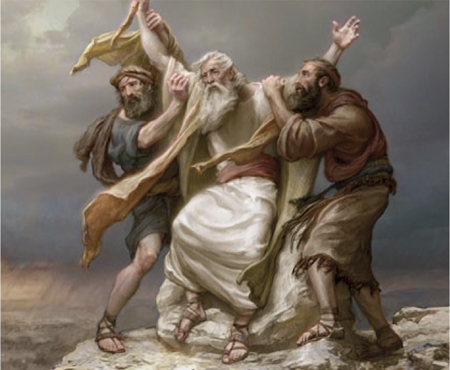
In Exodus 17:8-16, the Israelites are in a battle against the Amalakites. Moses told Joshua that during the battle that he (Moses) was going to stand on top of a hill with the staff of God. Whenever Moses raised his hands and the staff of God, the Israelites were clearly winning the battle. When Moses grew tired and lowered his hands, the Amalekites were winning. Seeing this, Aaron and Hur- who were with Moses, put a rock under Moses for him to sit on and they held up Moses’ hands throughout the battle so that “his hands were steady until the going down of the sun.” The result? Joshua and the armies of Israel overwhelmed the Amalekites.

As Scott shared, this is a great picture of the power of intercessory prayer. When we develop the habit of prayer- and praying for others- we are engaging in a spiritual battle. Many times we are unaware about what the battle is, but we are to pray. There have been many nights when I have been awakened with a person on my heart to lift up in prayer. When we pray, we hold up the arms of the one we are praying for. When we pray, we are coming along side of them in the spiritual realm to encourage, champion, and support as our battle is not against flesh and blood but against principalities and powers.

Next time that prayer concerns are shared in your church- write them down and commit to lift them up. Put the prayer card of missionaries in your Bible and when you see them, go to war in the spiritual realm for them and their ministry. When you commit to praying for someone who is far from God- God uses the power of praying men and women to soften their hearts and create divine encounters to experience God’s love and grace through Jesus.

Posted in Uncategorized | Tagged | Leave a comment