Beyond the Ten Commandments

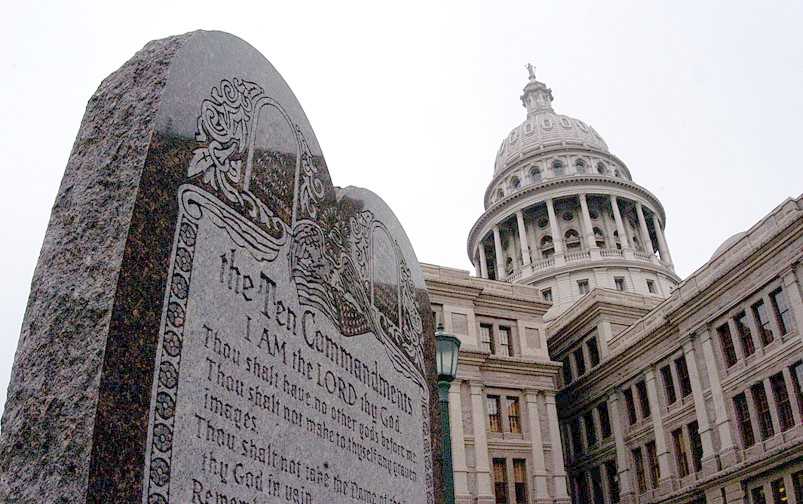
In 2005, The United States Supreme Court heard the case of Van Orden vs. Perry. What was disputed in the case was a monument of the Ten Commandments that was on the grounds of the Texas state capitol building. The organization that gifted the monument (in 1961) argued that the monument has both religious and secular importance. Others argued that a state placing a religious monument on state property violated the Establishment Clause of the First Amendment. 

I remember watching the news updates about the case and reading different articles about the case. It seemed that many believed that installing the Commandments was essential to restoring Godliness to our society. There is no doubt that the Commandments are vitally important to adherents of both Judaism and Christianity and yet installing monuments will not increase the morality or faith within our people. The same scriptures that record the Ten Commandments put that emphasis elsewhere.

Parents and the family structure play the most important role in passing on the faith we adhere to. 

  • Deuteronomy 6:5-9 |  “Hear, O Israel: The Lord our God, the Lord is one. Love the Lord your God with all your heart and with all your soul and with all your strength. These commandments that I give you today are to be on your hearts. Impress them on your children. Talk about them when you sit at home and when you walk along the road, when you lie down and when you get up. Tie them as symbols on your hands and bind them on your foreheads. Write them on the doorframes of your houses and on your gates.”
  • Proverbs 22:6 | “Train up a child in the way they should go, and when they are old they will not depart from it.”


Parents are the most influential voice in a child’s life. As disciples of Jesus Christ, we must be intentional about training our children to live as disciples. It is not a display of the Ten Commandments that will transform our society; it is Christians raising up emerging generations to radically follow Christ and love our neighbors with the love of God. We must go beyond wanting to display our faith through monuments and seek to display our faith through lives that have been transformed, shaped, and in the image of Jesus.


Posted in Discipleship | Tagged , | Leave a comment

Advent Devotions (Day 10) | Listen to Him

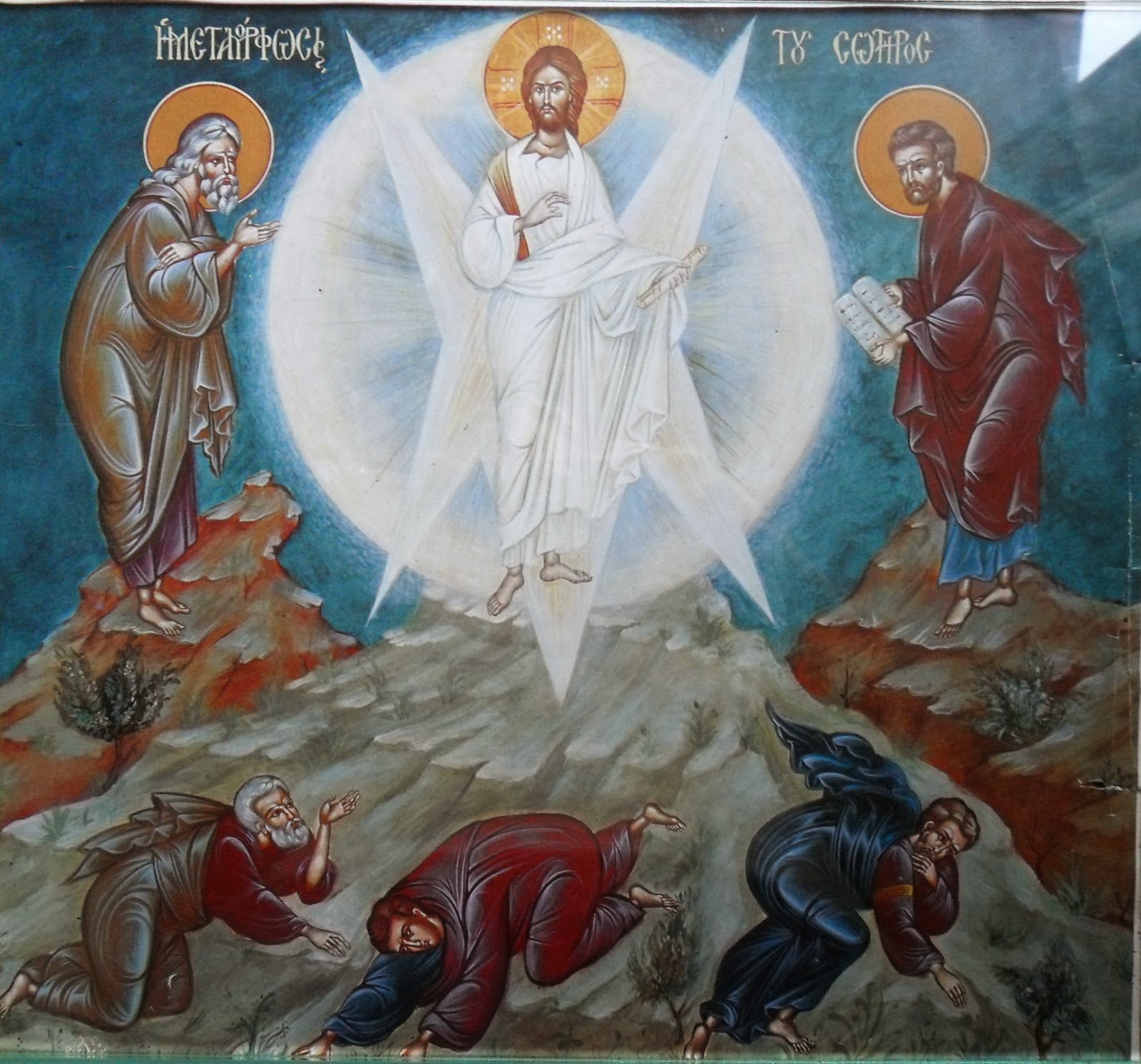
A few days ago, we looked at the story of Moses going up the mountain and encountering God. God’s presence was so real and tangible that Moses’ face was transformed. His face was so radiant that he had to wear a veil around others. There is a similar story in the Gospels about Jesus. We call it the Transfiguration.

In Matthew 17:1-9, Jesus takes Peter, James, and John to the top of a mountain. When they reached the top, Jesus was transfigured, and “his face shone like the sun, and his clothes became as white as the light.” On top of that, Moses and Elijah appear and converse with Jesus. These are two absolute pillars of the Jewish faith. Peter, James, and John are in awe. This was a supernatural encounter. Peter exclaims, “Lord, it is good for us to be here. If you wish, I will put up three shelters- one for you, one for Moses, and one for Elijah” (Matthew 17:4). While Peter was still speaking, a bright cloud appeared, and there was a voice from heaven saying, “This is my son who I love and with whom I am well pleased. Listen to him.”

When I read this story, I see Peter, James, and John wanting to stay on the mountaintop as long as possible. Who wouldn’t want to? They have just witnessed a supernatural spiritual event. Jesus was changed in front of them. Two heroes of their faith, long gone, appear before them. They want more of the experience.

Life is not one continuous mountaintop experience. We have to come down from the mountaintop. We cannot chase spiritual experiences or highs; we must learn to listen to Jesus. We must learn to be faithful to Jesus’ example and teaching. It is Jesus who transforms our lives. Rather than chasing after spiritual experiences, we must get to know the one who makes the experiences possible.

What are you doing to listen to Jesus? We must learn Jesus’ voice to follow Jesus in the low places and on the mountaintop.

God,
We are grateful for the mountaintop experiences
Where our faith is confirmed and built up.
Help us learn to listen to Jesus so that we might also
faithfully follow him in the low places as well.
Amen.

Posted in Advent, Devotional | Tagged , | Leave a comment

Advent Devotional (Day 9) | Lead Me Through It

“Do not be afraid, Mary, for you have found favor with God. 31 And now, you will conceive in your womb and bear a son, and you will name him Jesus. 32 He will be great, and will be called the Son of the Most High, and the Lord God will give to him the throne of his ancestor David. 33 He will reign over the house of Jacob forever, and of his kingdom, there will be no end.”[1]
Luke 1:30-33

Read Luke 1:26-38

I love going on rollercoasters. I am also terrified to go on a rollercoaster. Does anyone feel the same way? When I was in Middle School, my friend took me to Cedar Point in Sandusky, Ohio. Cedar Point is the rollercoaster Mecca in America. On one trip, Tommy and I waited over two hours to ride in the very front car of The Magnum. When we went, it was the tallest (over 200 ft) and fastest (72 mph) in the world.

We were filled with excitement as we waited in line. The closer we got to the ride, the more excited we became. We were bubbling with anticipation when we sat down in the front seat. But when the cars started moving and we began climbing the 200’ hill, I was filled with dread. Somewhere down that hill, I may have blacked out, but as the ride progressed, fear was pushed away by adrenaline. By the time we stopped, we were ready to ride again.

I imagine that life felt a bit like a rollercoaster for Mary. An angel appeared before her, telling her she would miraculously have a child. This would not just be any child but would be called the Son of the Most High! That thrill must have turned to agony over convincing Joseph, her fiancé, that this was from God. In the end, Mary responded, “May it be to me as you have said.” In the excitement and fear of the moment, she said yes to God.

Sometimes, God calls us to do something that fills us with excitement and even trepidation. One preacher said, “If God leads you to it, God will lead you through it.” Mary was given everything she needed to treasure the excitement and handle the challenges ahead. As you say yes to God, you will be called into deeper levels of intimacy and obedience; God will give you everything you need to follow where God leads. You may need to hold tight because it will be quite the ride!

God,
Give me the courage to follow wherever you lead me.
Help me to enjoy the times of blessings and to be faithful
in times of struggle.
Be near me at all times.
Amen.


[1] The Holy Bible: New Revised Standard Version (Nashville: Thomas Nelson Publishers, 1989), Lk 1:30–33.

Posted in Advent, Devotional | Leave a comment

Advent Devotions (Day 8) | Peace

The post below is something that I wrote back in 2018 on here on the blog. I wrote it as something to be read while our congregation would light our Advent Candles. This past Sunday, we lit the candle of Peace. We live in a world where peace is hard to come by. So let me share this post with you:
—-
Through our Advent Journey, we have practiced a rhythm of watching and waiting by looking at God’s faithfulness, love, and the joy that God brings us. This morning, we light the Candle of Peace. Our scripture is from Micah 5:2-5

But you, Bethlehem Ephrathah,
though you are small among the clans of Judah,
out of you will come for me
one who will be ruler over Israel,
whose origins are from of old,
from ancient times.”

Therefore Israel will be abandoned
until the time when she who is in labor bears a son,
and the rest of his brothers return
to join the Israelites.

He will stand and shepherd his flock
in the strength of the Lord,
in the majesty of the name of the Lord his God.
And they will live securely, for then his greatness
will reach to the ends of the earth.


And he will be our peace
when the Assyrians invade our land
and march through our fortresses. [1]

 We live in a frantic world. A world full of anxiety and worry. Even as we approach Christmas, many of us are filled with stress about the details of Christmas gatherings, managing our finances, the prospects of seeing certain relatives, or the reality of a holiday without a loved one. The Most Wonderful Time of the Year can quickly become The Most Stressful Time.

Micah describes a coming leader who will “be our peace even when the Assyrians invade our lands.” Sometimes, it is easy to miss this in hearing the text, but if the Assyrians are invading, then there will be destruction, there will be death, and there will be suffering. The Word of God says that “When” this happens, this leader will be our peace. Our strength. Our security.

When your job lets you go, when you begin life without a loved one, when your finances don’t seem to match up, when that relative reminds you that you’re not doing something right, and when your faith seems to be doing somersaults- Jesus will be our peace. The prophet Isaiah reminds us:

And he will be called
Wonderful Counselor, Mighty God,
Everlasting Father, Prince of Peace.[2]

Let us Pray:

Almighty God,
In these troubled times, help us to find our security and our protection in the shadow of your wings. Send the presence of your Spirit in our lives so that we might be filled with peace amid life’s storms.  We ask these things in the name of Jesus, our Savior. Amen.

Posted in Uncategorized | Tagged , | Leave a comment

Advent Devotions (Day 7) | A Strong Tower

From the ends of the earth I call to you,
I call as my heart grows faint;
lead me to the rock that is higher than I.
For you have been my refuge,
a strong tower against the foe[1]

Read Psalm 46 and 61

There is an epic battle in J.R.R. Tolkein’s The Lord of the Rings series at Helm’s Deep. The forces of Rohan find refuge and fight the evil forces of Saruman. King Théoden once said, “the Hornburg has never fallen to assault.” If you’ve either read the book or watched Peter Jackson’s incredible film adaptation of the books, you know that the Sauraman’s forces nearly prevail. But the fortress in the rock provided the protection that Rohan needed to claim victory.

Look through pictures and illustrations of castles and fortresses and you will find that they often claim the high ground. This make it easier to see and enemy approaching and to have the best offensive and defensive position. These strong towers provided safety for the men and women in the kingdom.

The psalmist cries out to God to “lead me to the rock that is higher than I.” The psalmist longed for God’s protection and provision. God is our “strong tower” against the foes that we face. In Psalm 46, the writers proclaims that God is “our refuge and strength, an ever-present help in times of need.”  By the time we get to the gospels, we see Jesus telling Peter that he [Jesus] is the rock that the church will be built upon (Matthew 16:18).

Do you need to seek “the rock that is higher than I?” Throughout our lives we will be under assault from principalities and powers. We will need to find refuge. God is our refuge and strength. God is our help. God is our strong tower against our foes. As God to lead you to the rock, the fortress, and to give you refuge from every assault of the enemy.

God,
You are our strong tower.
You are our refuge and strength.
Help us in times of trouble.
Protect us from the powers that comes against us. Amen.


[1] The New International Version (Grand Rapids, MI: Zondervan, 2011), Ps 61:2–3.

Posted in Uncategorized | Tagged , , , , | Leave a comment

ADVENT DEVOTIONS (Day 6) | On the Mountain

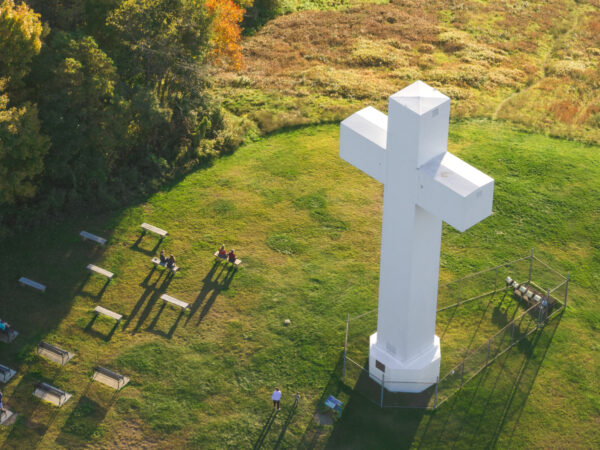
The Great Cross of Jummonville is seen by a drone.

30 So when Aaron and all the children of Israel saw Moses, behold, the skin of his face shone, and they were afraid to come near him.
Exodus 35:30

In Middle School, I attended church camp at Jumonville in South Western Pennsylvania. One of the features of the camp is that they have a large 60-foot steel cross that can be seen for miles. God worked powerfully in my life at this camp. My life is different because of the way that I encountered God at Jummonville. Years later, I took some young men from my church as part of a whitewater rafting weekend. We spent time in worship and prayer below the Jummonville cross. For me, this mountaintop cross was sacred ground.

In Exodus, God calls Moses to Mt. Sinai for a little face time. While Moses was on the mountain, God began laying out the commandments and what it looked like for Israel to be the people of God. When Moses came down the mountain, something had happened. Exodus tells us that “the skin of his face shone” to the point that the Israelites were afraid. Moses’ encounter with God was so powerful that it changed his physical appearance. God was with Moses on the mountain, and Moses was filled with God’s presence.

In our life with God, there will be mountaintops where we experience the presence of God in such a powerful way that there is a near-instant transformation in our lives. Just as the people saw Moses’ skin “glowing” in the presence of God, our lives will reflect that we have had a mountaintop experience.  

As Christians, we should make it a habit to meet with God regularly. Sometimes, these meetings will feel mundane. Other times, God’s power and presence will fill our lives in a new way. Daily Bible Study, prayer, and weekly worship should be regular habits for spending time in God’s presence. Camps, retreats, and conferences can be mountaintop experiences because we have set aside so many distractions to encounter God. God is with us when we intentionally set time aside to meet with Him. God is with us on the mountaintops.

Almighty God,
We thank you for the times we have encountered your Spirit.
We praise you for the transformation you have made in our lives.
Help us to be open to your Spirit on the mountain and
To seek your presence in the mundane.
Work in us today; we pray. Amen.

Questions:
1. Where have you experienced a mountaintop experience? What made it powerful? How were you changed?
2.  How do you regularly come into the presence of God?

Posted in Advent, Devotional, Faith | Leave a comment

Sermon | GOD IS WITH US IN OUR DOUBTS

[This is the sermon manuscript from the 12/3/2023 worship service at Avenue Church. You can watch the sermon here.]

Sermon Text: Luke 1:5-25

In The Polar Express, a doubting boy boards a magical train on Christmas Eve, and is headed for the North Pole. Adventure after adventure befalls him and a little girl who becomes his friend as they are guided along by the conductor.

As the train ascends a particularly steep hill, the threesome climbs down into the coal car from the top of the engine. The conductor is telling them to watch for ice when the boy slips. The conductor grabs him just in time and swings him back on board, which reminds the conductor of his first trip on the Polar Express. As they return to the train, they talk about what it really means to believe.

Conductor: Years ago, on my first Christmas Eve run, I was up on the roof making my rounds when I slipped on the ice myself. I reached out for a hand iron, but it broke off. I slid and fell. And yet, I did not fall off this train.

Girl: Someone saved you?
Conductor: Or something…
Girl: An angel.
Conductor: Maybe! (but said with the conviction of a Yes!)
Boy: Wait, wait! What did he look like? Did you see him?
Conductor: No, sir. Sometimes, seeing is believing. And sometimes, the most real things in the world are the things we can’t see.

As we begin the season of Advent, a season where we hope in things we cannot see, we are starting a new series called God With Us. One of the names of Jesus, proclaimed in the gospels, is Immanuel- which means God with us. We may not physically see God, but we believe that God is there. We believe that God is not in some distant place but with us in every situation. This morning, I want us to consider that God is With Us In Our Doubts.

Neither Our Lineage nor Our Work Will Keep Us From Hardship or Doubt

Zechariah and Elizabeth were righteous and blameless, and they still encountered hardship. Doubt was part of their story. Luke records,

In the days of King Herod of Judea, there was a priest named Zechariah, who belonged to the priestly order of Abijah. His wife was a descendant of Aaron, and her name was Elizabeth. Both of them were righteous before God, living blamelessly according to all the commandments and regulations of the Lord. But they had no children, because Elizabeth was barren, and both were getting on in years. [1]

Zechariah and Elizabeth were good people, and maybe even great people amongst their peers. The words that Luke uses to describe the couple are the same that the Old Testament uses to describe Noah, Abraham, and Job. They were righteous before God. They lived blamelessly when it came to following the law. While they may not have been perfect, they wholeheartedly chased after the things of God. This is not bad company to keep!

There was a problem though, Zechariah and Elizabeth were not able to have children. We are not told whether they could not conceive or whether the conception ended in miscarriage. Infertility is a draining and traumatic set of circumstances for couples today, and it certainly was in Biblical times as well. It carried a stigma that a couple must have sinned in some way and were cursed. It is important today that we not continue that misconception and stigma.

Even though they were righteous and even though they were blameless for following the law, they still endured hardship. My guess is that more than once, they cried out to God, saying, “Why me?” or “Where are you, God?” Can you relate to that? Their lineage and good living did not exempt them from hardship or doubt.

Do Not Allow Doubt to Develop Disbelief

When we doubt when we have questions about anything, it can be a catalyst in our life for deeper learning or understanding. But there is a challenge that we can allow our doubts and fears to develop into disbelief.

Luke continues that Zechariah was selected to enter the temple and burn incense outside the Holy of Holies. This was a once-in-a-lifetime opportunity for Zechariah. While inside the temple, an angel of the Lord appears to Zechariah. As is common when one encounters one of the heavenly hosts, Zechariah is terrified. The angel states:

“Do not be afraid, Zechariah, for your prayer has been heard. Your wife Elizabeth will bear you a son, and you will name him John. 14 You will have joy and gladness, and many will rejoice at his birth, 15 for he will be great in the sight of the Lord.

The angel tells Zechariah that Elizabeth will not only conceive a child in her old age, but bear a son. This was a sign of blessing and favor. But Zechariah asks, “How can this be? I am an old man and my wife is getting along in years.”

This is nearly the same question Mary asks the angel when she is told she will bear the Messiah. Mary asks, “How can this be since I am a virgin?” In both situations, bearing a child seems out of the question. Mary’s response after hearing Gabriel’s explanation, is one of obedience. She says, “May it be to me as you have said.” Zechariah was struck mute by the angel Gabriel because “he did not believe” the angel’s words. There is a difference between doubt and disbelief. One can compel us forward. The other holds us back. Don’t allow your doubts to develop into disbelief.

God is With Us in Our Doubts (and even our disbelief)

Luke tells us that once Zechariah was struck mute, he went home to Elizabeth, and she became pregnant even in her old age. She went into seclusion for five months. Perhaps this was because they had raised their hopes before only to experience crushing loss. After five months of seclusion and seeing that the pregnancy had taken, Elizabeth said,

The Lord has done this for me,” she said. “In these days he has shown his favor and taken away my disgrace among the people.” [2]

In the midst of Zechariah’s doubt and disbelief, God never left the couple. God did not abandon them or punish them. You can make the case that when Zechariah became mute, he was experiencing extreme mercy and grace from God that corrected him and guided him back to the pathway of faith and hope. When the baby was born, and named John, Zechariah regained his voice and praised God. The people were amazed. God had upside down this story of doubt, disbelief, and despair. I imagine that Zechariah and Elizabeth’s devotion to God and their faith increased through this experience. Doubt, when we pursue answers in God and Christ, can be a catalyst for greater faith.

I wonder how many can relate to Zechariah’s story this morning. We have come to a place in our lives when we have moved past doubts and questions and into the realm of disbelief. We may come to church each week, we may read our Bibles, we may even go through the motions of prayer but deep down we do not believe that God is on our side. We do not believe that God is for us. We can lose hope amid trying and difficult circumstances.

The season of Advent begins by lighting the candle of hope. We hold onto the hope that light will soon shine even when there is deep darkness in the land. We hold onto hope that when we are gripped by sin, God’s grace covers us.  We have hope that even when we cannot see it, God is still working. We have hope that even in our doubts God is with us.

There are some here who are on the verge of disbelief. We’ve lost hope that God will work in our lives, or maybe we’ve never encountered God’s presence, love, and grace in a real way. We would be wise to take up the prayer of the father pleading to Jesus to heal his son: “I believe, help my unbelief.”

As we begin the Advent season, let us not allow despair and disbelief to have any foothold in our lives. Let us use our doubts to catalyze a deeper faith and relationship with Jesus Christ. May we live each day filled with hope that no matter how dark life seems to be, God is with us through it all.


[1] The Holy Bible: New Revised Standard Version (Nashville: Thomas Nelson Publishers, 1989), Lk 1:5–7.

[2] The New International Version (Grand Rapids, MI: Zondervan, 2011), Lk 1:25.

Posted in Advent, Sermons | Tagged , , , | Leave a comment

Advent Devotions (Day 5) | The Thin Line

“I am the Lord’s servant,” Mary answered. “May your word to me be fulfilled.”
Luke 1:38

Read Luke 1:8-38

I grew up near Pittsburgh and always heard about “the confluence of the Allegheny and Monongahela Rivers” to form the Ohio River. When you stand in Point Park, where the rivers all meet, it is cool and ordinary at the same time. There are a few places where two rivers meet and never mix. As in the picture above, you can see the unique colors of the rivers that carry different sediment. There is a thin line separating each color.

There is a fine line between doubt and disbelief.

Chapter One of the Gospel of Luke introduces us to Zechariah and Mary. Both are key figures in the birth narratives. Both have encounters with the angel, Gabriel. Zechariah and Mary are both told about an impending miraculous birth. Interestingly enough, both have similar responses recorded in Luke. Zechariah says, “How can I be sure of this? I am an old man, and my wife is well along in years.” Mary replies to Gabriel, “How will this be since I am a virgin.”

Luke implies that while their responses are similar, Mary responds from a place of humble obedience, while Zechariah responds with disbelief. They have the same responses but very different postures of their hearts. It is possible that Zechariah allowed his lifetime of disappointment of no offspring to allow his doubt to develop into disbelief. In her humility, Mary told the angel, “May your word to me be fulfilled.”

There is a thin line between doubt and disbelief. While doubt can be a catalyst for deeper faith, disbelief can harden our hearts to the things of God. The good news is that God was with Zechariah and Mary. God is with you today as well.

God of miracles,
We come to you today filled with questions and requests.
Some of us need to know you are with us,
While others need a miracle.
Help our hearts to remain soft and obedient to your Word.
Fill us with your grace.
In Jesus’ name,
we pray. Amen.

Posted in Advent, Devotional, Faith | Tagged , , , , , , , , , , | Leave a comment

Advent Devotions (Day 4) | Is It Punishment or Grace?

“The angel replied, ‘I am Gabriel. I stand in the presence of God, and I have been sent to speak to you and to bring you this good news. But now, because you did not believe my words, which will be fulfilled in their time, you will become mute, unable to speak, until the day these things occur.

Luke 1:19-20

What would it be like to be unable to speak for nine months? This is the challenge that Zechariah faced because of his disbelief. Nine months of being unable to speak to his wife, Elizabeth. Nine months of being unable to communicate easily with his neighbors and friends. It is likely that for those nine months, Zechariah would not have been able to serve as a priest in the temple because of his muteness.

Zechariah had a few options for handling his inability to speak. The first option was to be angry with God. The sudden onset of muteness took away his ability to speak, fully engage in his relationship with others, and participate in the temple. His identity as a husband and priest was, in some ways, challenged by his inability to speak. Zechariah could express anger with God.


The second option would be to see this discipline as an ‘extreme example of divine grace.’ I imagine that the longer Zechariah was mute, the deeper his conversations with God were. The more he saw Elizabeth’s pregnancy advance, the more his faith increased. The writer of Hebrews says,

“God disciplines the ones he loves…”

God’s discipline of those God loves is not meant to be punitive but meant to nudge us back onto the path of discipleship and complete surrender and dependence on God. When Zechariah could speak again, his overflowed into praise and worship of God, who is faithful and who is with us.

Maybe you are experiencing what feels like divine punishment- could it be divine grace? Is God nudging you back into a right relationship? We each have a choice to make, to become angry with God, or to surrender our lives to God and trust that God is with us.

God,
Thank you for the discipline that you show us
Because you love us.
Help us to surrender daily to your will.
Give us the strength to trust you and to follow your ways.
Amen.

Posted in Advent, Devotional | Tagged , , | Leave a comment

ADVENT DEVOTIONS DAY 3 | Turn Your But Around

“In the days of King Herod of Judea, there was a priest named Zechariah, who belonged to the priestly order of Abijah. His wife was a descendant of Aaron, and her name was Elizabeth. Both of them were righteous before God, living blamelessly according to all the commandments and regulations of the Lord. But they had no children…”
Luke 1:5-7a

Have you ever questioned God because of what you were going through? Many of us have endured some hard times and cried out to God. “How long?” we may ask. Perhaps we’ve said, “Why me, God? I am a good person. Why am I going through this hardship?” We can believe that who we are or what we do will prevent us from hardship. This is not what the Bible teaches.

Zechariah and Elizabeth made an extraordinary team in Luke 1. The Gospel of Luke regards some incredible words about them. Zechariah was a priest from the priestly order of Abijah. Elizabeth was a descendant of Aaron, the brother of Moses and the first priest of Judaism. Luke says they were both righteous, words reserved for the likes of Noah and Abraham, and that they were blameless in their ability to follow God’s law. Their lives would have been examples of piety and devotion to everyone around them.

But…

You almost know it’s coming. Luke says all these good things about Zechariah and Elizabeth, BUT Elizabeth is barren. They were unable to have children. This would have been seen as divine judgment by their neighbors. I imagine Zechariah and Elizabeth spent years crying to God to give them a child. When the angel, Gabriel, told Zechariah that his wife would bear a child in her old age, Zechariah did not believe him. Zechariah and Elizabeth’s righteousness did not prevent them from experiencing hardship, doubt, and disbelief.

Perhaps we need to turn our “but” around (insert Middle School joke here).

Rather than focusing on the “injustice” of our hardship and asking God, “Why me,” we can see our hardship and say, “But God is with me.” We can experience the world’s trials and temptations and say, “But God is faithful.” We can walk through the valleys and proclaim, “But God is good.”

Zechariah and Elizabeth experienced a lifetime of loss, but God still heard their prayers because God was with them. God is with you today. Let’s turn our buts around!

God,
The human experience is filled with pain and loss,
But you are good.
We regularly fall
short in our devotion to you and our love for others,
But you are faithful.
Too often, we turn our back on you and run the other way,
But you are with us.
Be near us today, and help us to focus our hearts on your faithfulness.
Amen.

Posted in Uncategorized | Leave a comment