
“God imparts to us His heart for restoration, and a burning desire to see His love and justice heal the nations. But if we’re really to have integrity in our worship, somewhere along the line this desire has to turn into action: share our food with the hungry, clothe the nake and satisfy the needs of the oppressed. We cannot be worshippers who simply walk by, ignoring the realities of this broken world. God longs to bring us to the place where we ache so much with His heart that to do nothing is simply no longer an option.”
Matt Redman
In The Unquenchable Worshipper
Friday’s Quotation: Matt Redman on Worship
Posted in Worship
Leave a comment
Book Review: The Justice Project
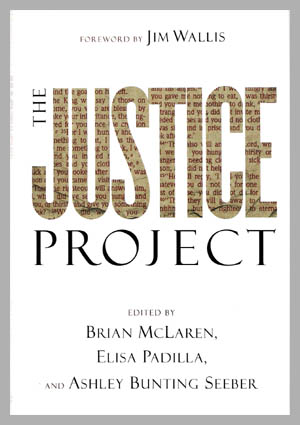
I recently received the book, The Justice Project, in order to read and review it. The book boast an all-star cast of contributers from Brian McLaren, Tony Jones, Peggy Camplolo, Rene Padilla, Lynne Hybels, Bart Campolo, and others. There are also many contributors who I had not heard of, but was thankful for because they represented various ethnic backgrounds and locations. This book is not just written my white, western men, but seeks to find more of a global approach to the idea of justice.
The book consist five sections (The God of Justice, The Book of Justice, Justice in the USA, A Just World, A Just Church) where each section consist of small chapters or articles on various topics that would fall under each category. I appreciated that there was an attempt to view justice from both a liberal and conservative lens as well as creating space to challenge many presupposed ideas of justice for someone, like me, who grew up in a conservative, evangelical home/church. There were several noteworthy chapters and thoughts throughout the book, but I will not go into detail here.
My critique of the book is that no one topic gets fully fleshed out. Yes, the entire book speaks of justice but so many of the chapters could have been turned into 2 or 3 chapters- or maybe even an entire book. Just as you get your appetite whet for what the author is saying, the chapter ends. In this way, there is little flow in the book from idea to idea other than the articles being grouped under one of the five sections.
I’ve been thinking about how I would use this book, other than personal reading/study. In a group setting, it might be more useful to pull an article around a topic rather than trying to read the entire book. It could also be used for study around the five sections and talk about the ways in which the articles work in the sections.
Overall, I thought this was a good effort by McLaren and company, even if it fell short of my expectations. Regardless, the Church must continue to wrestle everyday with what it means to “Do justice, love mercy, and walk humbly with God.”
Posted in Book Review
Leave a comment
A Psalm for Obama: A Response
Thanks to a link from Josh Hale, I read this article from the Christian Science Monitor. The article talks about a new slogan showing up on bumper stickers and twitter post that reads: Pray for Obama: Ps. 109:8. While this sounds innocent enough, when one checks the scripture reference, the Psalm reads,
“Let his days be few; and let another take his office.”
When I first saw this, I had to double check to make sure that wasn’t reading The Onion or some other satire site. But sure enough, it’s a legit story. Those who are passing along this passage along are using it display their dissaproval to Obama’s presidency and their hope that he only serves one term. Some people find the passage/reference as funny. Others find as possibly sinister as the passage could be interpreted (misinterpreted) to express hope that President Obama might serve less than one term.
I find this story troubling- especially if it is perpetuated by Christians. Here is why.
- This passage is taken out of context- Taken out of context, one can make the Bible say just about anything you want. This is very dangerous. This Psalm of David a song about one of David’s enemy- asking God to help him even this person is showing him evil. Is President Obama really an enemey? There may be some who disagree with his (or any President’s) politics, but does that really make him the enemey, or someone at the opposite end of the table?
- Another Example of Christians Being Negative- It seems, from the article, that there are Christians buying into this passage and bumper sticker. Why do we, as Christians, always have to be negative? If we put as much time into praying for President Obama and all our leaders as we do in complaining about them, I believe our nation and leaders would look different because there would be countless people on their knees intercessing on our leaders behalf rather than complaining (which accomplishes nothing).
We are called to pray for our leaders. 1 Timothy 2:1-2 is pretty clear,
“I urge, then, first of all, that petitions, prayers, intercession and thanksgiving be made for everyone- for kings and all those in authority, that we may live peaceful and quiet lives in all godliness and holiness.”
What if we prayed that God would bless President Obama with wisdom rather than just wishing he was out of office? What if we prayed that our Senators and Representatives would truly hear the cries of their consituents rather than blasting them? This would change our entire witness as the Christian church if we lifted our leaders up in prayer rather than gripe and complain.
My hope for the Church is that we surround President Obama and our other local, national, and world leaders in prayer. In this country, that we engage the issues with intelligent dialogue, seeking understanding and what is best for all people. We rely on our government officials to act on our behalf- and we need to lift them up that God would grant them wisdom in all that they do.
Posted in Uncategorized
1 Comment
Friday’s Quotation
“Brokenness in God’s kingdom is always redemptive. Jesus takes bread, blesses it, breaks it and gives it. Once we’ve been taken and blessed, we must be broken before we can truly be given.”
Christopher L. Heuertz in Simple Spirituality
**Simple Spirituality is a very challenging book. Heuertz chapter on brokenness was my favorite. If your not familiar with Heuertz or Word Made Flesh, go and check out this book!
Posted in Uncategorized
Leave a comment
Thank God for Answered Prayers
Yesterday, I was driving down towards the beach to stop at our local Comcast Cable office to pick up a HDTV cable box. I have to admit, I was pretty excited. The Steelers played last night and I was going to watch them in HD. As I sat at the light, a block or so from the office, my car stops running. Completely stops. And it won’t start back up.
I got out my car and motioned to the cars behind me that I the car wasn’t moving. Then I pushed my car off to the shoulder, more or less. I tried starting the car again, but with no luck. So I proceeded to call AAA to send out a tow truck because there was no where else I could push the car. Within minutes, I had a State Trooper behind me. Everyone was rubbernecking to see what kind of trouble I had gotten into. Speeding? Drug Bust? Texting while driving? DUI? Nope, just a boring breakdown.
The tow truck driver was very nice and helped me get my car back to my friends garage, and even drove me a mile back to my house. Now we wait to hear what the damage is. I guess there is a chance that the car is dead and that I might have to go find a new one. This would be very sad for 2 reasons. First, it would cost a lot of money that we were not planning on spending right now. Second, I have had that car since the summer before my Senior Year of college. We’ve been together for nine and a half years and nearly 160,000 miles. It is my last surviving item from college that I regularly use.
I have to admit, when I first broke down and the car wouldn’t start, I was truly thankful. Sounds strange. Each Tuesday morning, I leave the house early for a 98 mile trip up to my seminary. I drive the ever busy I-95 as well as the Blue Route. On Wednesday, I take the Skukyll, Blue Route, and I-95 back home. Every once in a while I see a car that is disabled along the side of the road. More than once, I have offered a prayer to God requesting that I would not break down while on a trip to Philly for school. God answered my prayers! Rather than breaking down in Philly, I broke down a day early in a place where it was easy to get off the road and a tow truck came in under 30 minutes. That would not have happened in Philly. (As an added bonus, no one flipped me off or called me names that I can’t repeat here like they would’ve in Philly).
Thank you God for you mercies which are new every morning! Thank you that even though I dread the thought of replacing the car, that the car broke down in a place that was safe and less stressful than where I am going tonight. Continue to provide safety on all my travels. Your grateful child, Steve. Amen.
Doing Church on Purpose
At Avenue, we’re in the midst of our Stewardship Campaign with a series titled: “Living Under the Blessing Tree.” After two weeks, the feedback has been really positive as we stress generosity in all we do. The messages for the last two weeks have been spot on. I had the privilege of preaching during the first week which focused on Paul giving thanks for the church at Philippi at the beginning of the book of Philippians. This week, the message came from Mark 2:1-12. This is the passage of the four friends who dig through the roof of a home to lower their paralytic friend down to see Jesus. Of course, when he gets lower, Jesus first forgives the paralytic of his sins, which causes a stir among the scribes. So, Jesus continues to completely heal the man. Everyone was amazed.
As I listened to the message, I considered some of the implications of the text for the Church. Our pastor encouraged us that each committee, team, meeting, group within the church should regularly ask this questions:
“How will what we do tonight in this meeting/group/study/worship service/etc. help someone get close to Jesus?”
That’s really the million dollar question for us. By asking this question, it helps us to refine our focus as we gather for council/leadership meetings. It refines what we do in youth ministry or our music ministries. This question holds us accountable to who and what God has called us to be. Just as the four friends worked to get the paralytic man to Jesus, how will what we do in our churches help others get to Jesus?
Now, some might say that everything we do in the Church is intended to bring people to Jesus. That might be the hope, but sometimes we do it without any intentionality or purpose. If our meeting has a printed agenda- the purpose of that meeting should be typed at the top, taking into consideration about how the outcome of the meeting will help bring someone closer to Jesus.
There is a warning to the church here in Mark 2:1-12 as well. It is heart warming to see these four friends overcome obstacles to get the paralytic man to Jesus….but who were the obstacles? They were the scribes, religious leaders, and others gathered to hear the message of Jesus. In essence, they were the Church! The gathering of people had become so focus on what was happening inside the house (Jesus teaching), that they were not aware of the needs right around them.
I read once from Erwin McManus that as a church, we have become content to look in the mirror when we should be looking out the window. We (the church) can run into the trap of being so inwardly focused that we miss out on the needs of our community just outside our doors. If the crowd that had gathered in Mark 2:1-12 had seen the four friends and the paralytic man, they could have made a path to Jesus and helped bring someone closer to Jesus.
Are we, as a Church, so inwardly focused that we are keeping others from getting to Jesus? Do we take time to stop and consider how our staff meeting, leadership team meeting, etc. are designed to bring people closer to Jesus? Are we intentional about it? My prayer is that as Christians, church leaders, and teachers that we would do all we can to help people experience the love and grace of God through Jesus Christ.
Posted in Bible Thought, Church, Leadership
Leave a comment
Friday’s Quotation: Eleazar S. Fernandez
“Liberation from want is a fundamental necessity in the restoration of one’s humanity. No one can be fully human in a situation in which one’s basic needs are not being met….as Robert McAfee Brown argues, ‘as long as children are growing up in a society where their parents cannot get jobs, so that children grow up undernourished, as long as people cannot get decent housing or education and health care for their children, human rights are being violated.'”
-Eleazar S. Fernandez
Reimagining The Human: Theological Anthropology in Response to Systemic Evil
In light of Pelosi’s health care bill, what do you think of this quote? Would you go as far as Fernandez to say that a person’s human rights are violated when they cannot provide the necessities for their families? What does it mean to be fully human? Talk it out below.
Posted in Uncategorized
Leave a comment
Going Beyond Discipleship
In our weekly staff meeting this past Monday, one of our staff people raised an interesting question. She asked why we are so caught up in Discipleship but not in making Apostles. A disciple, according to the HarperCollins Bible Dictionary, is a learner, an apprentice, a pupil. An apostle is someone “who has been sent out,” a person commissioned to transmit a message. I’m not writing to debate whether or not there should be an official office of the church called Apostle, but rather how do we get people from being learners to leaders?
When one examines the Gospels, we see the various accounts of the disciples. They followed Jesus around for three years. The disciples learned by watching, observing, sitting at Jesus’ feet, and by doing. The disciples were prone to mistakes and misunderstanding what Jesus was talking about. But then something happened. When we leave the Gospels and come to the book of Acts, the disciples are filled with the Spirit and begin carrying on the ministry of Jesus. They have become Apostles. They have graduated their internship and commissioned to move out from Jerusalem to Judea and the ends of the earth. They face persecution where they previously fled (when Jesus was arrested). They are now even willing to die for their faith. These uneducated men have moved from disciples to apostles- from learners to leaders of a movement that is alive and well today.
I’m guessing that our church is like many churches around the country and world. We value discipleship. We value growing in our relationship with God. We value learning. We value learning so much that many who are in our pews have no desire to move out into leadership. Our church, like many other churches, offers a large selection of Bible Studies and small groups to help our members grow in their faith. Yet I think there is sometimes still a struggle to put our faith into action…to move from the classroom and into the world.
How can the church move members from being learners to leaders? It takes an intentional effort to disciple in a systematic way. Just as Jesus gathered 12 men around him, I believe that one of the roles of the pastor is that of a mentor who should gather people around them to encourage them in their faith and help them move from learners to leaders. When the time is right, those the pastor mentor will disciple a new group of learners with the hope of developing a group of Christians who will get caught up in the movement of Jesus Christ.
Does your church wrestle with moving from learners to leaders? How does your church approach discipleship? What are you doing to intentionally move from learner to leader? Talk it out below!
Posted in Church, Leadership
2 Comments
Fernandez on Economy
“Econmics is not simply a matter of production, but one of care: care for the overall well-being of both human beings and the rest of creation. Care is a basic element in the oldest definition of the Greek word oikonomia or economy. Our conception of economics must recover this dimension.”
-Eleazar S. Fernandez
Reimagining the Human: Theological Anthropology in Repsonse to Systemic Evil
Posted in Uncategorized
Leave a comment
Lessons Learned from Trick or Treating
Where I grew up in Pennsylvania, there were no neighborhoods to go trick or treating at. Mom and Dad drove us in a car for 5-6 houses of people that we knew out in the country. Even driving, this took quite a long time. When Andrea and I moved to Delaware and purchased our home, we live in a large neighborhood. In those first few years, we would see close to 250 kids come to our door. This year, with Abbie being 2, we met up with a group of friends and went trick or treating together. These are some lessons I have learned from the last six years that you should keep in mind.
1. Trick or Treating With Friends is More Fun: Like almost any other activity, a large group makes the evening more enjoyable.
2. Trick or Treating is not socialism: While our group was fun- there was (a joking) suggestion of pooling all the loot and dividing it equally. Trick or Treating is a winner takes all sport. If you can get the better candy- more power to you.
3. Find the Young, Wealthy Neighborhood: This may sound like social profiling, and it is. Our neighborhood used to be the exciting neighborhood to visit on Halloween night. But our numbers have continually decreased the last two years. We found out why tonight. The neighborhood behind us has bigger homes, and bigger candy. I’m all for stopping in someone else’s neighborhood, especially if you can get in 5 houses what normally takes 10 houses in your own neighborhood.
4. Shake the dust of your feet at those who don’t participate: Yeah, you could egg their home or toilet paper their trees…but shaking the dust of your feet as you leave their yard is the proper Biblical response. These are the same people who say Ba-humbug at Christmas.
5. No Double-Dipping Unless You Change Costumes: Hitting up the same house twice (or three or four times) is just wrong. but if you have the ingenuity to change costumes and hit the same houses again, I will gladly reward you with more candy. I think all kids should be encouraged to think outside the box when it comes to Halloween.
6. Speaking of Costumes- No Costumes, No Candy: This is a hard and fast rule. I was amazed in our neighborhood the amount of kids who would come up to the house without a costume. Where is the creativity? Even if money is tight, certainly there are things around the house that can be used for a costume. One year, it was so bad that I told Andrea that I was going to put up a sign that said “No Costume, No Candy.” Lucky for some kids, I never did.
7. Shame on Parents who collect candy for the baby in the “car.” Or maybe the baby is back home. At least let me see the baby dressed up in some sort of costume. You and I both know that you are the one who is going to eat the candy. At least let me see your kids so I can give you the candy with a slightly clear conscience.
What are some of your rules or lessons that you’ve learned from Halloween past? What would you add to the list?
Posted in random
Leave a comment
 Exiled Community