Check Yes or No

Do you remember when you were in love and you’d get a love note from your boyfriend or girlfriend.  I can remember when this would be the highlight of the day- and especially as a middle school boy, the love note was far preferable to actually talking to someone- especially on the phone.  My family still had a corded phone when I was in middle school- one with a 25 foot cord.  When a girl would call I would take the phone from our downstairs living room and stretch it up to my upstairs bedroom so my parents or sister wouldn’t hear any details of puppy love.  
The only problem with the note was how it was folded.  My experience in middle school and high school with notes was that it was like solving a Rubik’s Cube trying to open the letter up.  The most creative I could get was a paper airplane while they are sending me an origami goose or a ninja star (if I was lucky!).  While I looked forward to the words inside the note, I also anticipated how the note was folded. (A bunch of crafty people!) 
When you’d first get a note from someone you like- or send one…they would always end with these words:  Do you like me? Check yes or no.  
A love note requires a response.
This Sunday, we’re beginning a sermon series called “Crazy Love” based of the book by the same name, and written by Francis Chan.   This Sunday, we’ll be talking about one of God’s love notes to you and to me: Creation.  In Creation God reveals a crazy, relentless, unconditional, and everlasting love.  Over the next several weeks, we’ll be talking about that all important response as we seek to grasp God’s love for us and how we can live in that love everyday.

What’s the best love note you’ve received?  What’s the best “folding” you can do for a note?  What is your favorite love letter from God?

If you’re in the Dover, Delaware area, check us out at www.hopedover.com.  We worship at 9:30 a.m. in the Wesley College Chapel at the corner of Division and Bradford St.  Can’t attend- listen to the sermon online!

Posted in sermon idea | Leave a comment

On The Verge: The Silver Imagination

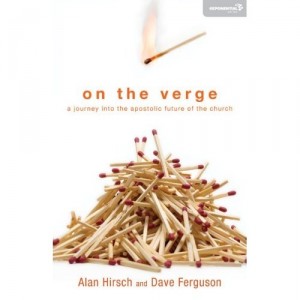
(I recently began reading a copy of Alan Hirsch and Dave Ferguson’s new book, On The Verge: A Journey Into the Apostolic Future of the Church.  I have been looking forward to reading the book as I have enjoyed the other books that I have read by Hirsch (especially ReJesus).  Over the next few weeks, I will be posting some thoughts from the chapters that I am reading.)

Let me put this out there from the beginning- I loved this chapter.  I’m further along in the book and there is good stuff to come- but as I read The Silver Imagination, it got my juices flowing.  I consider myself a big picture/vision oriented kind of leader…and this chapter in On The Verge challenged my imagination and the imagination of my leaders about what God is doing- and can do in and through our churches.

Alan tells the account of Ivan Illich who was asked what he thought was the most radical way to change a society.  Rather than answering through a violent revolution or gradual reform, Illich said that if one wanted to change society, one must tell an alternate story (pg. 57).  In the church, we have this great story from creation to the final redemption of creation through Jesus Christ- yet we need to find, imagine alternate ways of telling this story as our communities and cultures change.  In the States, as we grow increasing pre-Christian, we must tell the story (and live the story) differently than we did 20 or 30 years ago.  It’s a paradigm shift.

The key, according to Hirsch, is imagination.  Hirsch writes that imagination is not just for child’s play or fantasy, but is a God-given gift of our mind that allows us to live and minister in creative and new ways.  Imagination allows us to explore possibilities that we have never before considered.  Hirsch writes, “…the fundamental job of apostolic imagination is to produce out of the church we now experience a vision of the church Jesus wants us to experience” (68).

In my previous minister appointment, I was an associate pastor at a church that had been around for over 200 years.  It was an institutional church.  Ministry at this church was most exciting and life giving when our paradigms began to change and we began to imagine a new way of making disciples of Jesus Christ.  I have recently completed my first full year as the solo pastor of a church that is less than ten years old.  While we don’t have the institutional baggage of a 200 year old church- we daily wrestle with what it means to be the church because many of our leaders (myself included) operate on an old paradigm of institutional church.  I pray for myself and our leaders that we would pray and create space to use our imagination to become the movement type church that turns the world upside down for Jesus.  I pray this prayer for all our churches that we would produce the church Jesus wants us to experience!

Posted in Book Review | Leave a comment

Why I Love VBS…

Hope United Methodist Church, where I pastor, just finished a four day Vacation Bible School last night.  We had a great time!  There is a lot of planning and work that goes into VBS. Ask any director/co-director and they will tell you how much time and prayer that goes into the week.  Inevitably, there comes a point in the planning (usually the week, or day before the start date) where the stress builds and you are led to wonder “Is all this work and preparation really necessary for VBS?”  Of course, in my experience, those feelings quickly go away once VBS starts and the music begins to play and you can see the joy on the children’s faces as they worship God.

Here is why I love VBS:

1.  The Memories: I grew up in the church, and as a kid, my parents took us to several VBS programs at area churches.  I remember playing kickball for recreation at North Salem United Methodist Church and VBS in the basement of Hadley Presbyterian Church. (By the way, I went back to Hadley Presbyterian Church this past year for my grandfather’s funeral, the children’s classroom looked exactly the same as it did 28 years ago! Even the same crayon bins!)  I don’t remember very many themes or songs- but I remember caring people who showed me that God loved me and that Jesus can change my life!

2.  The Kids:  I’m a former youth pastor- and I love being with kids of all ages.  I love seeing them have fun.  And most of all, I love seeing them worship God!  Our children are such a valuable resource, and we need to treat them as the treasures and masterpieces they are (Trust me, we’ve had a few pieces of work at VBS!). Our mission or task as a church is to make disciples.  What better time to do that than childhood?  Children can begin developing practices and habits of disciples at an early age- and it is our responsibility to train them!

3.  The Adults:  We had incredible adult leadership this year. As I walked around each station, there were several times when I thought about how talented and gifted our adults are.  It is exciting to see adult serving where their passion is!  It truly makes a difference.  I’m sure that our leaders are tired after the week, but as we look back, there were seeds planted at VBS that will need to be cultivated and cared for- and that over time will grow and bloom into something truly beautiful.  Our adults, whether they were taking pictures, handling registration, serving snack, or leading a station was planting the seeds of God’s love every time we loved on a kid.

A lot of time and resources go into a week of Bible School.  As a pastor, I think VBS is worth every penny and hour spend because of the seeds of faith that we plant.  When a child is baptized in our churches, the congregation makes a vow or covenant with the family of the baptized child that as a church, we will provide everything possible to ensure that the child is raised to know Jesus Christ as Lord and Savior.  This is a high and Holy calling for every church and every Christian who has made that covenant to fulfill.

What is your favorite Bible School memory or story?  Did your VBS use puppets- did you love them or were you terrified of them? 

Posted in Uncategorized | 1 Comment

A Brief Encounter With Path1

I had the opportunity to briefly attend a feedback session that Path1, the board/organization in The United Methodist Church working to plant churches, had with our conference (The Peninsula-Delaware Conference).  When I say briefly, I had to leave midway through the meeting for the launch of our Men’s Ministry that same night.  But I came away with a few thoughts- especially as I currently pastor a 7 year old church plant in the heart of our conference.

The presenter provided some compelling statistics (and being a baseball fan- I like statistics!)  Just two to share with you.

  • The United Methodist Church is losing 1200 members a week.
  • 67% of new attenders in our churches were invited by laity rather than clergy

First, about membership…I’m not sold on tracking membership.  There’s nothing in the Bible about membership…but we are to be making disciples…bringing people to a place in their life where they confess that Jesus Christ is Lord and growing in their faith so to be mature.  A “New Members Class” looks alot different if we are concerned about membership instead of professions of faith and people starting their discipleship journey. Being a members speaks to knowing the organizational code, benefits, and belonging to the “club.”  Being a disciple means we’ve encountered the transforming love of God and are being called out of our “holy huddle” in order to invite others to participate in this God-life.

The second statistic about new attenders responding to the invitation of laity rather than clergy says a couple of things.  First, laity need to catch the vision of bringing people to faith in Christ and growing as disciples.  They must understand the priesthood of all believers.  Laity must grasp the joyous opportunity to invite people to participate in God’s Kingdom and God’s Kingdom community- the Church. 

What discouraged me about the brief part of the meeting that I attended was that the present talking about getting people into our pews.  When I heard that statement, I felt that we were trying to revitalize old paradigms where we expect the unchurched to come to us, and come into our churches (hopefully, they will come and tithe as well!).  If the UMC is going to plant new faith communities- we need to embrace new paradigms of what “church” is.  Maybe it’s a home church, a cell church.  Maybe it’s the pastor and/or laity discipling in the coffee shops, gyms, and community centers.  Maybe it will take losing the emphasis on our buildings, our rituals, our liturgy, and our institutionalism in order to go to the people and compel/inspire/give witness that JESUS CHRIST has made a difference in our lives and wants to transform their lives as well!

Path1 is meeting with our Congregational Development group today.  I pray that God’s wisdom and a passion for reaching the lost moves us to be open to embracing new paradigms of ministry that we have not even imagined yet!

Posted in Uncategorized | Leave a comment

On The Verge: Chapter 1

I recently began reading a copy of Alan Hirsch and Dave Ferguson’s new book, On The Verge: A Journey Into the Apostolic Future of the Church.  I have been looking forward to reading the book as I have enjoyed the other books that I have read by Hirsch (especially ReJesus).  Over the next few weeks, I will be posting some thoughts from the chapters that I am reading. 

Introduction and Chapter 1:

In the introduction, the authors liken the current state of the Church to a “phoenix arising from the dying embers of Christendom” as they view the Church of the future.  They believe that the the Christian Church is standing at a pivotal point in history- hence the idea of VERGE…that we (the Church) are on the verge of something new and yet ancient. 

What does it mean to be “on the Verge” or a “Verge” Church?  Hirsch and Ferguson write that what was once in conflict with one another (incarnational or attractional) are now beginning to interact with one another.  This interaction has all sorts of missional implications, according to the authors, including a new paradigm for the Church that “fundamentally altars the nature of the game.” The authors believe that the Church can attractional and missional at the same time if the organizational DNA incorporates a both/and approach that is able to contextualize the Gospel of Jesus Christ in the Western World.

For most of the first chapter, Hirsch and Ferguson talk about shifts in the Church.  On page 32 the authors write:

“Adopting a Verge church paradigm requires learning what it means to become a more fluid, adaptive, reproducible, viral people-movement.  In other words, it means taking seriously the idea that the church Jesus built- and therefore what he intended- is meant to be more of a movement than an institution.”

In short, chapter one is setting up the movement….moving from an institutional church to a movement (or Verge Church).  This is a challenging and exciting step for the Church to consider.

I am currently a pastor in The United Methodist Church.  What was once a great missionary movement in the 1700-1800’s has now become an institution.  As I read the opening pages of “On The Verge,” my heart rate increased as I considered what the Church could look like if it could once again become a movement rather than an institution. 

Posted in Book Review | Leave a comment

Lebron James and Wisdom

Shortly after losing the NBA Finals to the Dallas Mavericks, LeBron James had some interesting words to say;

“All the people that was rooting on me to fail, at the end of the day they have to wake up tomorrow and have the same life that they had before they woke up today, they have the same personal problems they had today. I’m going to continue to live the way I want to live and continue to do the things that I want to do with me and my family and be happy with that. They can get a few days or a few months or whatever the case may be on being happy about not only myself, but the Miami Heat not accomplishing their goal, but they have to get back to the real world at some point.”

Naturally, all sorts of people got on LeBron about the comments and what they appear to communicate.  This post is about judging, but about considering the people in our lives who mentor and guide us.  I’m not sure who mentor’s LeBron James- or if he has a mentor.  Likely, if he did, his mentor wouldn’t be too thrilled with these comments. Too many times, in sports and Hollywood- celebrities are more in-tune with their entourage than an older and wiser mentor.

In 1 Kings 12, Rehoboam has ascended to the throne and is beginning his rule as King.  Some people come and speak to Rehoboam about lightening the work and tax load on the people.  Rehoboam took time to go to the old men who had been advisors and mentors to his father, Solomon.  They replied that Rehoboam should be a servant to the people, and that if he becomes a servant that the people will be loyal to him.  Verse 8 reads,

“But he abandoned the counsel that the old men gave him and took counsel with the young men who had grown up with him and stood before him.”

 Rehoboam went to his entourage for guidance.  They, in turn, told the newly crowned King to say “My father disciplined you with whips, but I will discipline you with scorpions.”  They counseled the King to be even harsher on the people.  Rehoboam disregarded the wisdom of the older generations.

I don’t know who mentors Lebron, but you know who your mentors are.  It is very wise for each of us to seek out an individual(s) who are older, wiser, and more mature in their faith to regularly meet with for guidance in our life and faith.  We must embrace the older generations for the wisdom that they can pass down to each of us.

Likewise, we must ask- “Who are we mentoring?”  What teenager/college student/young adult are we pouring our life, our prayer, our time, and our wisdom into?  This is how we make disciples- one at a time.

What is the best piece of wisdom that a mentor has ever given you?  What’s the best book your mentor ever recommend reading?

Posted in Leadership | Leave a comment

Blue Like Jazz: The Movie

I’m pretty intrigue to see the Blue Like Jazz movie. I loved the book.  The trailer hasn’t done anything to change that.  What do you think? Are you excited to see Blue Like Jazz: The Movie or not?  Do you think Steve Taylor can direct the movie in such a way that appeals to people outside of the TBN/Christian Movie crowd?

Posted in Uncategorized | 2 Comments

The Mission of Jesus: Monday Follow Up

Yesterday, we began our summer sermon series called, “The Mission of Jesus” where we will be walking through the Gospel of Mark and examining the life and mission of Jesus as we consider how we are to live as disciples and as a church.  This Sunday, we began with Mark 1:1-15 and focused on verse 15 where Jesus says that the Kingdom of God is near.

One area that we did not get to spend a particular amount of time with was Jesus’ baptism in v. 9-11.  When Jesus comes out of the water, he sees the heavens torn open and hears a voice declaring, “You are my Son, whom I love; with you I am well pleased.” Mark tells us that the Spirit led Jesus out into the wilderness where he was tempted by Satan.

What is important in this passage is that before Jesus could fulfill his mission, confront Satan, and bring about redemption- Jesus had to know to whom he belonged.  The declaration that Jesus is God’s Son is the assurance and certainty that whatever happens Jesus has confidence that he is God’s Son and loved.

We need that assurance as well.  We need to know that when we encounter the wilderness, when we encounter trials and temptations, when we encounter the storms of life that we are children of God.  We need to have confidence in the fact that God loves us.  When we grasp that we are children of God, that God loves us as God’s own- this can carry us through all that live throws at us.

As you go about your week, remember whose you are so that when you face trials of any kind that you can have assurance that you are a child of God.

Posted in Bible Thought | Leave a comment

What’s Your Story?

Yahoo News ran a story yesterday about a Pennsylvania Pastor, Jim Moats, who claimed service as a Navy SEAL to a local paper as part of a story in the days following the killing of Osama bin Laden. The pastor, who confessed to the fabricating story, evidently purchased a Trident medal at a military surplus store and wore it around town- as well as telling what Navy SEAL training was like to the paper.  But to some real SEALs who read the article, they recognized that his story closely paralleled depicted in the Steven Seagal classic “Under Siege.”

Really? You ripped off details from a Steven Seagal movie?

Now, this pastor is not the first person to make up a story (read: LIE!) about their military service.  Several politicians have been caught spinning tales about their military careers.  But one quote in the story is really telling.  It comes from retired SEAL Don Shipley.  He says, “We deal with these guys all the time.  Especially the clergy.  It’s amazing how many of the clergy are involved in those lies to build that flock up.” (Note: It was Shipley who said the pastor’s tale sounded more like “Under Siege” than real SEAL experience.)

Clergy are “those guys” who fabricate stories about military service?  Where is our integrity as pastors?

Do we really need to “puff up” our testimonies and personal stories in order to lead people to Christ?  Can’t a boring conversion story of been in the church all my life and God has been faithful just as powerful of a testimony as the skid-row to front row of the church testimony?

Pastors, leaders, and fellow Christians- when we have to lie to share our faith, it destroys our character and damages our witness and the witness of those Christians who have integrity in their lives and ministry.  The story of our faith is not tied up in who we are and what we have done (whether mundane or great), but our story of faith rest firmly upon the foundation of what God has done through Jesus Christ in our life.  That we have been redeemed and reconciled through the life, death and resurrection of Jesus- God’s Son.  Our preaching, teaching, and our testimonies should rest on what God has done, not what we have done.

What’s your faith story? Mundane? Fantastical? Have you ever been tempted to embellish your story? What did you ultimately do?

Posted in Uncategorized | Leave a comment

A Hypocritical Christian?

What does your life (actions/words/choices) say about your beliefs?

I’ve been wrestling with this question for a few weeks now.  Sure, many of us would say that we base our actions, words, and choices on our belief in God and what we read/study in the Bible. As Christians we seek to follow what the Bible lays out.  Fair enough.

But when do we become hypocritical in our beliefs and our walk as Christians?

This isn’t as negative statement as it sounds…simply, how far do we go to actually live out the life that Jesus lived- and at what point do we say- “That’s a really awesome way of life, but I’m not there yet?”  We all do this to one degree or another.  I certainly do this (so if you think I’m finger pointing- I’m pointing at me here!).  Here is some examples…

The Sermon on the Mount (Matthew 5):  In this passage we find some kingdom ethics or praxis.  Here are some examples:

  • (5:21)While the Torah says “do not murder,” Jesus says that anyone who gets angry at a brother or sister will face judgement.  How do we do with our anger towards other? Do we seek forgiveness and reconcilliation?
  • (5:27) You’ve heard it said, “Do not commit adultery”, but Jesus says that when we look at another person lustfully, that we commit adultery in our hearts.  How do we do with what we put before our eyes? 
  • (5:38) “You’ve heard it said, “eye for eye, and tooth for tooth.”  Jesus says that when someone strikes us, that we should turn the other cheek.  This is passivity- it’s nonviolent resistance. Are we (Am I) are quick to embrace violence rather than finding nonviolent alternatives to our problems? (I could (and may) go into a longer post on what I think are some of Jesus’ ethics regarding nonviolence and peace as a way for Christians to seek to live.  It’s fascinating stuff- starting with this verse!) Some of this is most recently seen in Gandhi and Martin Luther King, Jr. and the ways in which they brought about change without using violence.
  • (5:43) “You have heard it said ‘love your neighbors and hate your enemies,” but Jesus says- “love your enemies and pray for those who persecute you.”  Wow.  I once heard that we pray for our enemies not because it necessarily changes the enemy (although it can), but because we are changed when we pray for those who come against us.  We begin to see them not as subhuman, but as people who are lost and hurting.  

I could go on with the Rich Young Ruler (Sell all you have and give to the poor) and other teachings of Jesus.

I’ve been wrestling with this because I believe that Jesus came not just to show us the way to eternal life with God- but that Jesus came to show us how to live right now.  When we live according to Jesus’ example, the Kingdom of God is revealed here on earth as it is in heaven.  It may only be a short glimpse, but that glimpse can begin to change lives.  This glimpse of the kingdom can bring reconciliation between sworn enemies. It can bring together families who have been broken.  It can restore marriages.  It can heal racial and ethnic tensions and bigotry.  Does this sound idealistic? Only because it is so foreign in our day and time. 

Check out this passage from 2 Corinthians 5:16-21

So from now on we regard no one from a worldly point of view. Though we once regarded Christ in this way, we do so no longer. Therefore, if anyone is in Christ, the new creation has come: The old has gone, the new is here!  All this is from God, who reconciled us to himself through Christ and gave us the ministry of reconciliation:  that God was reconciling the world to himself in Christ, not counting people’s sins against them. And he has committed to us the message of reconciliation.  We are therefore Christ’s ambassadors, as though God were making his appeal through us. We implore you on Christ’s behalf: Be reconciled to God. God made him who had no sin to be sin for us, so that in him we might become the righteousness of God.

 We have a ministry, as Christians, to bring people to a place of reconciling with God and with our neighbors.  We do this by living as Jesus lived.  By taking seriously his teachings and example.  When we do this, change can begin to take place in our families, communities, and the world.

So where does your hypocrisy kick in?  It’s ok to admit it- in fact, we probably need to do some confession in our churches and ‘fess up to our hypocrisy.  Let’s face it- churches are full of hypocrites, and I am one of them.  Churches are for hypocrites.  The hope is that in the context of community that we will become less and less hypocritical and more like Jesus.

Feedback:  What is a saying or teaching of Jesus that you have a hard time embracing? Use the comments for some discussion!

Posted in Bible Thought | 1 Comment