
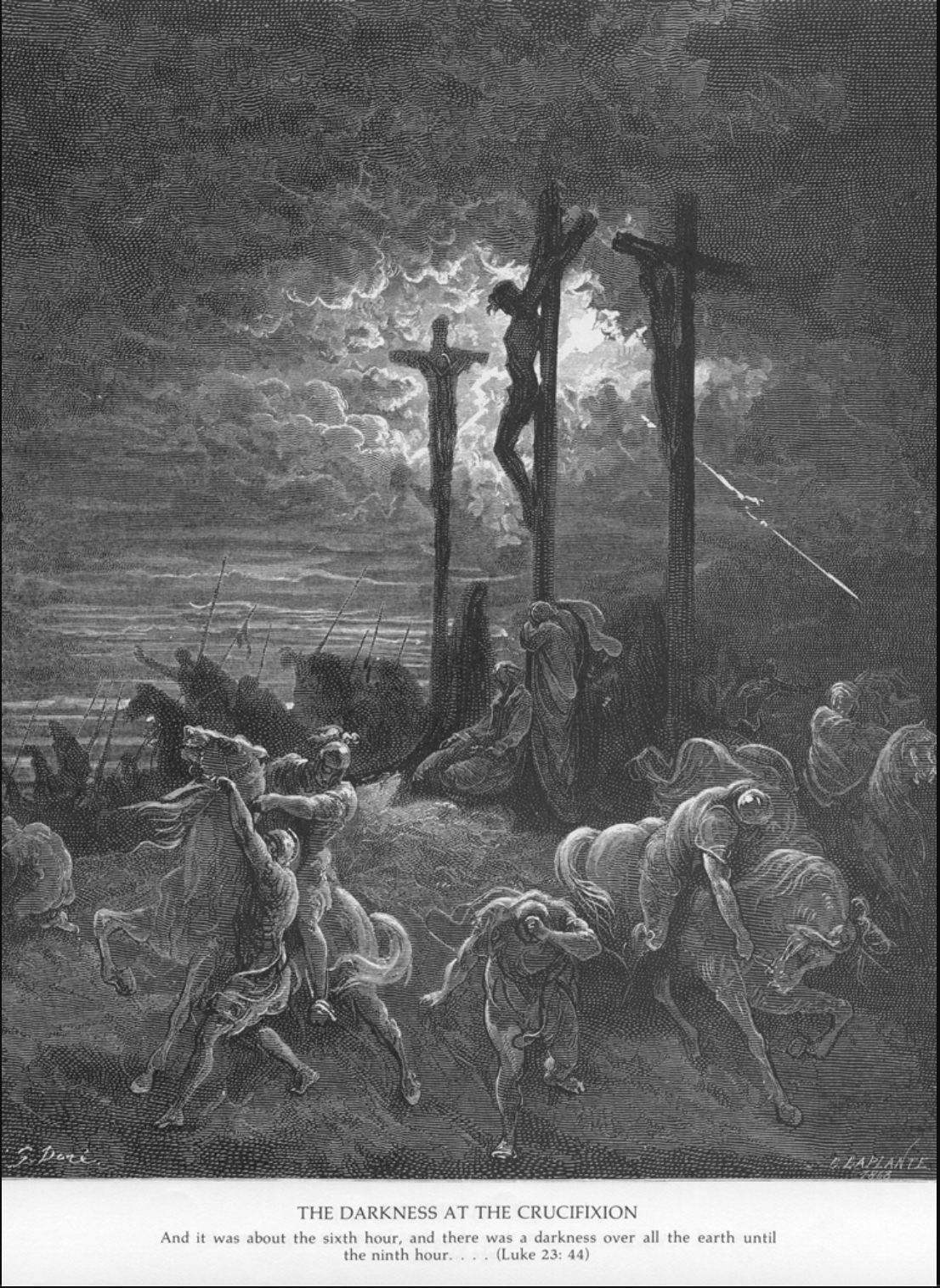
[Good Friday Meditation From Avenue United Methodist Church, April 18, 2025.]
On Holy Thursday, we gathered to remember how Jesus humbled himself and took the position of a servant, washing the feet of his disciples. Tonight, we will recall how Jesus humbled himself even further by dying a criminal’s death on a cross.
Today is a challenging day. As Christians, we are invited to reflect on Jesus’ death on the cross. Thinking about death is hard enough, but reflecting on the kind of death that Jesus endured is even harder.
There was a seminary that created a series of online advertisements for an upcoming course on atonement theories, which are images in the Bible that tell us what Jesus did on the Cross. Facebook would not allow the ads on their page because they said that the Cross was an instrument of violence. In a blog post, the seminary actually agreed with Facebook, stating that the cross was an instrument of death. But it is on that cross that sin and death are ultimately defeated.
Tonight, we gather to consider the cross of Jesus and reflect on what Jesus took on when he was nailed to it.
In John 19:16-18, the gospel writer records:
So the soldiers took charge of Jesus. 17 Carrying his own cross, he went out to the place of the Skull (which in Aramaic is called Golgotha). 18 There they crucified him, and with him two others—one on each side and Jesus in the middle. [1]
If you grew up in the church or have seen The Passion of Christ or another similar movie, you likely have an image of Jesus carrying his cross. When we think about it, it is an intense form of degradation. It would be like someone holding their own electric chair or injection needle. Jesus carries his cross to Golgotha for the Roman soldiers to crucify him there.
Judaism, as a religion, was based on a sacrificial system dating back to the days of Genesis. There were prescribed sacrifices that had to take place based on the sins in our lives. There were constant sacrifices made at the tabernacle and the Temple to atone for the people’s sins. The priest would lay their hands on the goat or bull (or other sacrifice) and place the person’s sins on the animal. Then they sacrificed it. This went on for hundreds of years.
The writer of Hebrews states that “For it is impossible for the blood of bulls and goats to take away sins.”[2]
The writer of Hebrews continues:
“Every priest stands daily at his service, offering repeatedly the same sacrifices, which can never take away sins. But when Christ had offered for all time a single sacrifice for sins, he sat down at the right hand of God…for by a single offering he has perfected for all time those who are being sanctified.”[3]
When Jesus was crucified on the cross, the NT writers, under the inspiration of the Holy Spirit, understood Jesus’ death to be the final, perfect sacrifice for our sins. The sacrifice that paid the complete cost for our sin. Our sin, and the sins of the world, were placed on Jesus and destroyed at Jesus’ death, so we are forgiven and sanctified.
The simplest directions on what it means to start following Jesus come from Paul’s letter to the Romans. He writes,
“If you declare with your mouth, ‘Jesus is Lord,’ and believe in your heart that God raised him from the dead, you will be saved.”[4]
When we declare that Jesus is Lord and that God raised Jesus from the dead, we repent of our sin. Repenting is a 180-degree turn away from our sin and a turn to Jesus. In turning to Jesus, the sins that we carry are placed upon Jesus and nailed to the cross. We are forgiven, and our sins are remembered no more. Jesus became our sin. Paul writes in 2 Corinthians 5,
“God made he who had no sin to be sin, so that we might become the righteousness of God.”[5]
Jesus carried the Cross so we might be free from our sins. God’s love for you, me, and all of creation enabled Jesus to become sin so that we might be saved.
The question I want to ask tonight is this: Are you still carrying your sin? Are you still carrying your burdens? Have you asked Jesus to take on your sin so that you might be forgiven and saved?
On Tuesday, September 8th, 2015, a British Airways jet caught fire at the Las Vegas airport, sending smoke billowing into the air, after suffering what the pilot described as a “catastrophic failure” of the left engine. The plane—a Boeing 777 heading from the U.S. city’s McCarran airport to London Gatwick—could be seen with flames around its fuselage.
The pictures of a burning jetliner in Las Vegas were certainly riveting. But as the plane burst into smoke and flames, some observers saw something even more startling: People stopped during their evacuation to grab their luggage. Authorities are certainly concerned about planes bursting into flames, but they’re also worried that we might risk our lives to grab our carry-on bags.
So what’s the big deal with grabbing one carry-on bag? The FAA requires planes to be evacuated within 90 seconds, but as a Chicago-based air traffic controller wrote:
Let’s say the average delay time per bag is 5 seconds. This includes the time needed to reach up to open the overhead compartment, pulling the bag down, and the extra delay hauling it through a crowded aisle. If half of the 170 people on board Flight 2276 took the time to take their bag the evacuation would have taken an additional 7 MINUTES longer than necessary. Imagine being the last one to exit the smoke-filled cabin, knowing that your one-minute evac time is now over 7 minutes!
One veteran pilot with a major U.S. airline said, “We’re always shaking our head. It doesn’t matter what you say, people are going to do what they do.” Or as one blogger summarized this news story: “People love their carry-ons more than life itself.”
For many of us, we love carrying our burdens. We love carrying our sins. We hold on to them as we have allowed them to shape our identity. We have become comfortable with our sin- and even the effects of our sin in our lives and on the relationships we have with God and others.
Jesus went to the cross to take on our burden. He went to the cross to take on our sin- to become sin so that we might be forgiven and saved. We have to let go of our baggage, our sin; we have to confess and repent so that Jesus can take our baggage for us.
The Good News of Good Friday is that Jesus’ death lifts the burden and frees us from our sin. What do you need to leave at the Cross? What baggage are you holding onto that is preventing you from experiencing the life that God offers through Jesus Christ? Leave it at the Cross.
[1] The New International Version (Grand Rapids, MI: Zondervan, 2011), Jn 19:16–18.
[2] Hebrews 10:4, NIV.
[3] Hebrews 10:11-12, 14, NIV.
[4] Romans 10:9, NIV.
[5] 2 Corinthians 5:21, NIV.

 Exiled Community